Every landlord software company publishes a price. Almost none of them publishes the total. The number on the pricing page is what the landlord pays. The larger number, the one that decides whether this software is actually cheap, is what your renters and applicants are charged to interact with it. We went and read the pricing pages. Here is what we found, with the arithmetic shown.
There are two prices, and only one of them is advertised
Ask a landlord what their software costs and you get a subscription figure. Ask what leaves the building every month and you get a pause, because nobody counts the other side. Yet the other side is where a meaningful share of this industry's revenue comes from: a fee on the application, a fee on the rent transfer, a percentage on the card, a charge for the lease document. Those are not incidental. For several platforms they are the business model, and the free or near-free landlord tier is the customer acquisition cost that the model pays for.
None of this is hidden, exactly. It is published, in smaller type, on a row of the pricing table you were not reading because you were comparing the big numbers at the top. So let us read the small type. Every figure below came off a vendor's own pricing page, and every one is dated.
Exhibit A: TenantCloud prices your renter's fee off your subscription
This is the single most revealing line in the category, and it sits in plain sight on TenantCloud's own pricing page. The ACH fee on a rent payment, marked as paid by the tenant, is:
| Landlord's plan | Landlord pays | Renter pays per transfer |
|---|---|---|
| Starter | $18/mo ($15 annual) | $1.95 |
| Growth | $35/mo ($29.17 annual) | $1.75 |
| Pro | $60/mo ($50 annual) | $1.50 |
Sit with that for a second. The renter's fee goes down when the landlord's bill goes up.
No bank charges less to move the same $2,000 because the landlord upgraded a subscription. The cost of an ACH transfer does not care what plan anyone is on. So this is not a pass-through of a bank cost. It is a pricing decision, and the person it is levied on is the one participant in the transaction who did not choose the software, cannot switch it, gets no say in the plan tier, and receives nothing at all for the extra 45 cents. A renter on Starter is subsidising a landlord who bought less software.
Charged every month across a year, that is $23.40 a year out of one renter's pocket on Starter, against $18.00 a year if their landlord had bought Pro. Small money to a landlord. Not small to the household that also just paid a deposit.
Exhibit B: at TurboTenant, the application fee is the product
TurboTenant's landlord-side offer is genuinely strong, and we have said so before: a free tier with unlimited units and no card required is the easiest yes in this category. The question is who funds it.
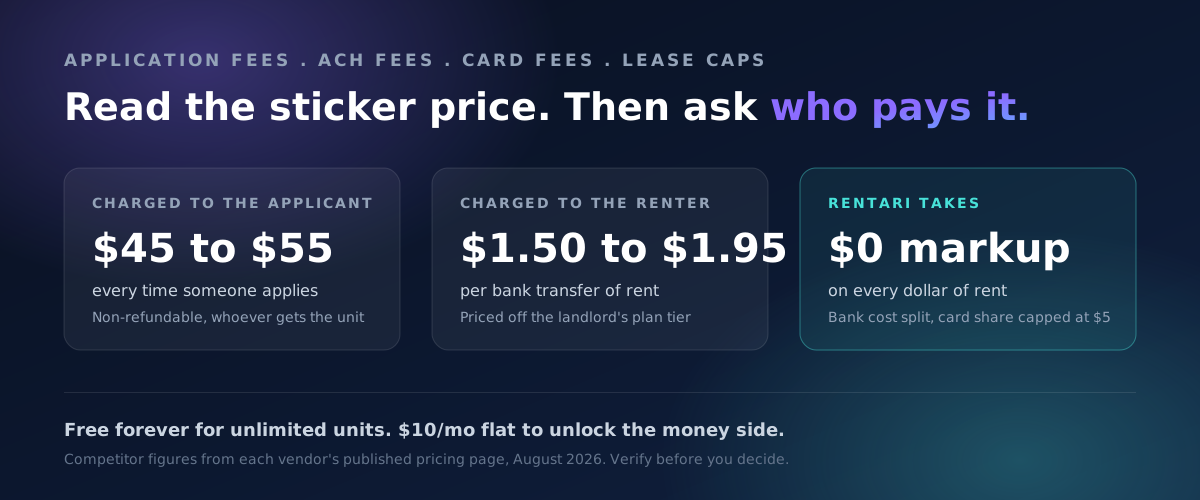
Applicants pay a screening fee of $55, which drops to $45 when the landlord is on a paid plan. It is non-refundable, and it is charged per application, not per lease signed. Card rent payments carry a 3.49% fee paid by the renter.
Run that on one competitive listing. A unit that draws ten applications collects $450 to $550 from renters. One of those people gets the keys. The other nine paid full price for a rejection. Do that four times a year across a small portfolio and the renters in your pipeline have collectively funded something in the region of two thousand dollars of software that was marketed to you as free.
Notice, too, which direction the discount runs. The applicant's fee falls by $10 when the landlord starts paying. Same credit file, same bureau, same report. The price of a renter's data moves with the landlord's subscription status, exactly as it does at TenantCloud. Two independent companies, no coordination implied or alleged, arriving at the same instinct: the renter is the flexible line item.
The friction you agree to before you have used anything
Price is only half of what makes software pleasant to live with. The other half is how much you have to commit, and how often the product interrupts you to ask for more. Here is what each platform requires of a landlord who has not yet decided anything, taken from published terms rather than from anybody's opinion.
| Getting in, and staying in | TenantCloud | TurboTenant | Rentari.ai |
|---|---|---|---|
| Free tier with no clock | No. 14 day trial only | Yes | Yes, unlimited units |
| Can you buy one month? | Yes, at a premium | No. Paid tiers are annual only | Yes, month to month |
| Cap on how many leases you may hold | 10 / 30 / 60 by tier | Not advertised | None |
| Does your renter pay a platform fee to pay rent? | Yes, $1.50 to $1.95 per transfer | Yes, 3.49% on card | No. $0 to us |
| Does an applicant's fee depend on your plan? | Applicant pays | Yes, $55 or $45 | No. Same at cost, every plan |
Read down the middle two columns and you find the same shape twice. The cheapest thing about these products is the moment you sign up. Everything after that is a gate: a clock that runs out, a year you have to buy in one go, a lease count that turns your eleventh tenant into a sales conversation, a fee your renter meets every single month.
The free tier is an acquisition instrument, and it can be taken away
TenantCloud built its early reputation on a free landlord plan. Go to their pricing page today and there is no free forever tier at all. There is a 14 day trial, and then the cheapest way in is $18 a month, or $15 if you commit to a year up front.
Here is the part that should worry you more than any individual fee, and we went and checked it rather than taking anyone's word. On August 19, 2026, TenantCloud's own homepage was straightforward: it offers a 14 day free trial and does not advertise a free plan. But the major software directory GetApp, which is where a great many landlords actually start their research, still listed TenantCloud as having a free version, and still showed a starting price of $25 a month against the $18 Starter on the vendor's own page. Reviewer feedback collected on that same listing includes concerns about price increases and about the discontinued free version.
We are not accusing TenantCloud of running a fake free tier. Their own site is clear. The point is subtler and worse: a free tier can be withdrawn, and when it is, the internet keeps advertising it for you long after it is gone. A landlord doing normal 2026 research can arrive at a trial believing a free plan waits at the end of it. It does not.
A free tier is not a promise. It is a growth stage, and growth stages end. If your leases, your ledger, your maintenance history and your tenant communications live inside a product whose free plan can be retired by a pricing meeting you will never attend, then your switching cost is the thing being monetised, not the software.
Lease caps: paying for permission to have tenants
TenantCloud advertises unlimited properties and unlimited units on every tier, which sounds generous until you find the number that actually binds. Leases are capped: 10 on Starter, 30 on Growth, 60 on Pro. Past 60 you are quoted a Business plan starting at $100 a month.
A lease is a row in a database. It costs a rounding error to store and nothing to keep. The cap is not there because the eleventh lease is expensive. It is there because the eleventh lease is the moment you cannot walk away, which makes it the ideal place to put a price increase. Signing one more tenant takes you from $180 a year to $350 a year. Nothing about the software got better. You just got harder to lose.
Consider what that does to the way you run your business. A cap on leases means the product has an opinion about your growth, and the opinion is that growth should trigger a bill. Software you have to negotiate with before you sign a tenant is not software that is on your side.
The user who never got to choose
Every conversation about ease of use in this industry is a conversation about the landlord, because the landlord is the buyer. So let us have the other one.
Your tenant did not evaluate this software. They did not read a comparison page, they did not weigh the tiers, and they cannot switch if they dislike it. They were handed a login and told this is how rent works now. And on both platforms above, the first thing that login does is present them with a fee: $1.50 to $1.95 to move their own money on TenantCloud, or 3.49% on a card at TurboTenant, which on a $2,000 rent is about $70 for the convenience of paying on time.
That is a product decision with consequences you will feel. A renter who is charged to pay rent has a reason to pay by check instead, and a check is slower, easier to lose, and impossible to reconcile automatically. A renewal conversation goes differently with someone who has spent a year being nickel-and-dimed by the software you chose. Ease of use is not only about your admin time. It is about whether the person on the other end of the transaction feels respected by the way you collect from them.
And there are fewer independent options than there were
Let us be precise, because the word gets thrown around and it does not apply here. This is not a monopoly. Landlord software in 2026 is a crowded, competitive market with a dozen credible products, and anyone telling you otherwise is selling something.
What is true is that the independents are consolidating. TurboTenant, which is backed by private equity, acquired Azibo on May 6, 2025, folding a financial services platform that served landlords in all 50 states into its own. That is one fewer company setting its own prices. Consolidation does not make anyone a villain, and acquisitions often genuinely improve a product. But it does mean the number of firms who can independently decide what your renter pays to send you rent is smaller this year than it was last year, and the direction of travel for a private-equity-backed rollup is not usually toward charging less.
Where they are cheaper than us, plainly
We are not going to run the trick where the comparison table is quietly rigged to the unit count that flatters us. On subscription price alone, at a larger portfolio, TenantCloud's flat tiers beat our per-unit maths, and here is the arithmetic that shows it.
At 50 occupied units, our Prime plan is $10 for the first five units plus $2 for each of the other 45, so $100 a month, or $80 a month if you pay annually. TenantCloud Pro covers 60 leases at $60 a month, or $50 annually. On the landlord's line item they win by $30 to $40 a month. That is real, and if the subscription line is the only number you care about, you should go and buy their Pro plan.
Now add the other side of the ledger, because that is the entire point of this article:
| 50 occupied units, annual billing | Landlord pays | Renters pay | Total out of the building |
|---|---|---|---|
| TenantCloud Pro | $50/mo | 50 x $1.50 = $75/mo | $125/mo |
| Rentari.ai Prime | $80/mo | Split of the actual bank cost, $0 to us | $80/mo plus bank cost |
Their landlord price is lower. Their household price is higher, by roughly $540 a year taken from the fifty people who live in your buildings. Which number matters is a judgement call and it is yours to make. We only insist that you make it with both numbers in front of you, which is more than the pricing pages give you.
What we charge, stated the same way we just demanded of everyone else
It would be worthless to write all of the above and then get vague about our own numbers, so:
- Free forever, and it is not a trial. Unlimited properties and units. Listings, the lead pipeline from the major portals, applications with FCRA disclosures, and tenant screening are included at $0. No card to sign up, and no clock.
- Prime is $10 a month, flat, for up to five units. $96 a year if you pay annually, which works out at $8 a month. Extra units are $2 each, or $1.60 annually, with volume pricing down to $1.25 on large portfolios.
- Month to month. Cancel whenever you like. We do not require an annual commitment to see the real price.
- We add nothing on top of the rent. $0 Rentari markup. The bank fee on a transfer is split with your tenant at cost, and your card share never goes above $5. We are not pretending the renter pays literally nothing to move money, because banks charge for moving money. We are telling you that none of it becomes our revenue, and that it does not change based on which plan you bought.
- Screening is passed through at cost. No platform markup on the applicant's fee, and the price does not move with your subscription status.
- No lease caps. Sign your eleventh tenant without a conversation about tiers.
And to be even-handed about our own limits: our free tier includes ten maintenance tickets a month, and lease creation and rent collection are the things Prime unlocks. That is our paywall, and we would rather you read it here than discover it later.
Three questions to ask any vendor before you sign
1. What does my renter pay to send me rent, and does that number change if I change plans? If the answer to the second half is yes, you have learned that the fee is a pricing lever rather than a cost. 2. Across one filled vacancy, what is the total collected from every applicant, not just the one who got the unit? 3. Can I cancel next month? If the only real price requires twelve months up front, the trial was not the product.
The honest summary
TurboTenant and TenantCloud are not bad software and we are not going to pretend they are. TurboTenant's free tier will fill a vacancy well, and TenantCloud's accounting is solid at the top of its range. Both are legitimate choices made by serious people, and we have said where each one beats us.
What we object to is a pricing convention this whole category has drifted into, where the advertised number is aimed at the buyer and the real cost is quietly routed to the person with the least power in the arrangement. Renters cannot shop for landlord software. They get whatever their landlord picked, and then they pay for it, per application and per transfer, without ever seeing a pricing page. Meanwhile the landlord gets a trial clock, an annual commitment, and a cap that turns growth into an upsell.
We built ours the other way round. Start free with no card and no clock, pay monthly if and when the product earns it, add your eleventh tenant without asking anyone, and send your renters a way to pay that costs them nothing extra to us. The landlord's price is the price. If that costs us the 50 unit comparison on a spreadsheet somewhere, we will take it.
Sourcing, August 19, 2026. TenantCloud plans, lease caps, per-tier ACH fees and trial terms read directly from tenantcloud.com/pricing and tenantcloud.com on that date; their homepage advertises a 14 day free trial and does not advertise a free plan, and we checked that ourselves rather than repeat a third-party claim that it still markets a free tier, which did not hold up. The GetApp listing showing a free version and a $25 starting price, and the reviewer concerns about price increases and the discontinued free version, were read from getapp.com on the same date. TurboTenant's pricing page blocks automated access, so its figures come from multiple independent 2026 sources that agree on them: the $55 application fee reduced to $45 on a paid landlord plan, the 3.49% renter-paid card fee, and annual-only billing on the paid tiers. We have deliberately left TurboTenant's subscription price out of this article because published third-party sources disagree on whether the paid tiers are flat or scale with unit count, and we will not print a number we could not confirm at the source. Where this article says a term is "not advertised", it means the vendor does not publish it, not that it does not exist. Verify every figure here on each vendor's own site before you decide anything; plans and fees in this category change often. The Azibo acquisition was announced May 6, 2025. Rentari figures are our own published pricing as of August 19, 2026. All product names and trademarks are the property of their respective owners. Rentari.ai is not affiliated with, endorsed by, or sponsored by any company named here. This article is general information, not legal, tax or financial advice.