Most top-10 software lists are ranked by who paid. This one is ranked by portfolio size, every price was read off the vendor's own pricing page this month, and we tell you up front that we make one of the ten. Here is what each tool costs once you add the fees that do not appear on the pricing card.
Read this before the list
Rentari.ai publishes this comparison, and Rentari.ai is number four on it. You should weigh that. What we can offer instead of a promise is a method you can check: no composite score, no badge, no sponsored slots, and every dollar figure traced to the vendor's own pricing page on August 13, 2026. Where a competitor beats us, it says so. If you want to know how the ranking industry usually works, we wrote that up separately in how software rankings really work, including what a G2 Leader badge costs.
How the ten are ordered, and why there is no score
They are ordered by the portfolio size each one fits, smallest first. That is the variable that actually decides this choice. A tool that is perfect at four units is a liability at four hundred, and the reverse is just as true: a platform built for a 200-unit management company will bury a landlord with a duplex in modules they will never open.
We did not give anything a score out of ten. We make one of these products, so a weighted score would be ours to set, and you would have no way to check it. Portfolio fit you can check against your own door count in about five seconds.
The thing that makes these hard to compare
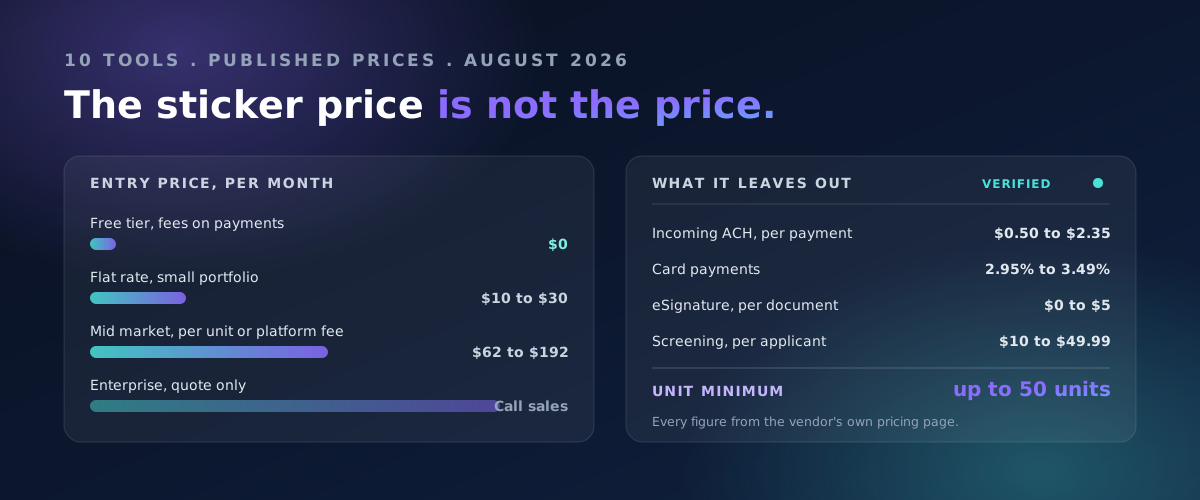
The monthly price is rarely the price. Four fees sit underneath it, and they are where the real difference shows up:
- Incoming ACH. The fee on each rent payment that arrives by bank transfer. Across this list it runs from no fee at all, which is Hemlane, up to $2.35 a payment on Buildium's entry tier. On ten units that gap is about $280 a year, which is larger than several of these subscriptions. Note that "no fee" and "no fee published" are different things, and the table says which is which.
- Card payments. Between 2.95% and 3.49% on this list. On $1,800 rent that is roughly $54 to $63 a month, per unit, and who absorbs it varies by platform.
- eSignature. Charged per document by some platforms, from $5 down to nothing depending on the tier you are on.
- Screening. From $10 to $49.99 per applicant, sometimes billed to you and sometimes to the applicant.
A fifth one is not a fee at all but decides the shortlist for many readers: the unit minimum. Some of the better-known platforms will not sell to you below 50 units.
The ten at a glance
| Tool | Entry price | Free tier | Incoming ACH | Fits |
|---|---|---|---|---|
| 1. Innago | $0 | Yes, the whole product | $2, tenant pays | 1 to 25 units |
| 2. TurboTenant | $0, Premium from $149/yr | Yes | $2 free plan, waived on Premium | 1 to 20 units |
| 3. Baselane | $0, Smart $20/mo | Yes | $2 | 1 to 20 units |
| 4. Rentari.ai | $0, Prime $10/mo | Yes, unlimited units | No platform markup | 1 to 1,000+ units |
| 5. RentRedi | $12/mo billed yearly | No | None published | 5 to 100 units |
| 6. TenantCloud | $15/mo billed yearly | No, 14-day trial | $1.50 to $1.95 | 10 to 60 leases |
| 7. Rentec Direct | $25/mo | No, 2-week trial | $2, or $0.50 on Pro | 10 to 500 units |
| 8. Hemlane | $0, then $30/mo | Yes, Starter | No fee | 5 to 100 units, remote owners |
| 9. Buildium | $62/mo | No, 14-day trial | $2.35 down to $0.60 | 50 to 5,000 units |
| 10. DoorLoop | $69/mo billed yearly | No | Not published | 10 to 300 units |
Entry price is the cheapest way in the door, using annual billing where the vendor offers it. Fit is our reading of the pricing model, not a vendor claim.
1. Innago, if you want the whole product for nothing
Innago is free to the landlord with no monthly fee, no setup fee and no contract. It pays for itself on transaction fees, which land on the tenant: $2 per ACH rent payment, 2.99% on cards, and $30 to $35 for a screening report the applicant buys. Leases, eSignature, applications and maintenance requests are all included.
Best for: a landlord with a handful of units who wants real software and refuses to pay a subscription for it.
The catch: free to you means billed to your tenant, and a $2 charge on every rent payment is a conversation you will have. There is no AI layer, so screening decisions, lease drafting and maintenance triage stay manual work on your evenings.
Pick it over Rentari if: you want rent collection at zero subscription cost and you are comfortable with the fee sitting on the tenant's side. Our rent collection sits behind Prime at $10 a month. Full Innago comparison.
2. TurboTenant, if marketing the unit is the hard part
TurboTenant's free plan is genuinely free and genuinely good at the top of the funnel: listing syndication, a lead inbox, online applications and screening. Premium starts at $149 a year, roughly $12.42 a month, and TurboTenant lists higher Premium tiers that scale with portfolio size. Premium waives the $2 ACH fee that otherwise falls to the tenant on the free plan. Cards run 3.49%.
Best for: a landlord whose main pain is filling a vacancy, not running the tenancy afterward.
The catch: it thins out after move-in. There is no AI co-pilot, so screening, leases, renewals and reminders are all done by hand, and accounting is light compared to anything on the second half of this list.
Pick it over Rentari if: your portfolio is small, stable and mostly needs a listing engine. Full TurboTenant comparison.
3. Baselane, if you want the bank account and the books in one place
Baselane Core is $0 and unusually generous for a free tier: unlimited checking and savings accounts earning interest, FDIC insurance through Thread Bank, physical and virtual debit cards with spend controls, property-level income and expense tracking, Schedule E reports and automated rent with reminders and late fees. Baselane Smart is $20 a month with a 30-day trial and adds auto-tagging, receipt matching, two-day rent deposits and balance sheets. ACH rent is $2, which you can absorb or pass on, and cards carry 3.49% paid by the tenant.
Best for: an owner who thinks about the portfolio as a set of accounts, wants per-property banking, and files a Schedule E.
The catch: it leads with banking and bookkeeping, so leasing and maintenance operations are thinner than the tools built around the tenancy.
Pick it over Rentari if: banking separation per property is the actual problem you are solving. Full Baselane comparison.
4. Rentari.ai, if you want the AI to do the drafting (this is ours)
Ours, and here is the honest shape of it. Free Forever covers unlimited properties, units and listings, a lead pipeline that catches Zillow and Apartments.com, online applications with FCRA disclosure and eSignature, tenant screening the applicant pays for, one inbox for chat, email and SMS with AI drafts, and 10 maintenance tickets a month. No card to start.
Prime is a flat $10 a month for 1 to 5 units, $8 a month billed annually, then $2 per additional unit up to 200, with volume discounts that fall to $1.25 a unit above 1,000. There is no unit cap. Prime is what unlocks the money side: leases with tenant eSignature, rent collection and autopay, accounting and trust accounting, inspections, lease review, AI screening summaries, team members, and Mozart, the AI co-pilot that prepares screenings, leases, renewals and late-rent notices for you to approve.
On rent collection we add no platform markup. To be precise rather than flattering: the processor's bank fee is split with your tenant, and your share on a card payment is capped at $5. That is not the same as free, and we would rather say so than print a rounder number.
Best for: a landlord or manager who wants the paperwork drafted rather than templated, at a price that does not jump when the portfolio does.
The catch, stated plainly: rent collection and lease generation are behind Prime, so the free tier stops at the point you sign a tenant. Innago and Stessa both collect rent at $0 subscription. If your entire requirement is free rent collection, they beat us on that specific line.
5. RentRedi, if you want one flat price and no unit math
RentRedi charges $29.95 a month billed monthly, $20 a month billed every six months, or $12 a month billed annually, and every plan includes unlimited properties, tenants and teammates. Unlimited eSignatures are included. There is no free trial, though there is a 30-day money-back guarantee. Screening is tenant-paid at $39.99, or $49.99 with income verification, and rent reporting to credit bureaus is $5.99 a month.
Best for: a growing landlord who hates per-unit pricing and wants the bill to stop moving.
The catch: the $12 headline requires paying a year up front, and month to month is two and a half times that. Screening at $39.99 is the most expensive on this list for the applicant.
Pick it over Rentari if: you want a single flat fee at any door count and you are happy to prepay the year. Above roughly 15 units, flat pricing starts to beat per-unit pricing. Full RentRedi comparison.
6. TenantCloud, if you want tiers that map to lease count
TenantCloud runs Starter at $18 a month, $15 billed annually, Growth at $35, $29.17 annually, Pro at $60, $50 annually, and Business from $100. The tiers are capped by leases rather than units: 10, 30 and 60 respectively. There is a 14-day trial and no free tier. Incoming ACH is $1.95, $1.75 and $1.50 by tier, screening is applicant-paid, and eSign is included throughout.
Best for: a manager who wants a conventional tiered SaaS product and a clear upgrade path.
The catch: the lease cap is the thing to watch. Crossing from 10 to 11 leases roughly doubles the bill, and ACH stays chargeable at every tier.
Pick it over Rentari if: you want a mature, well-trodden tiered product and the lease count sits comfortably inside a tier. Full TenantCloud comparison.
7. Rentec Direct, if the accounting has to be serious
Rentec Starter is $25 a month for up to 10 properties and tenants. Rentec Pro and Rentec PM are both $50 a month with unlimited properties and tenants, the difference being that PM is built for managing on behalf of owners. The first two weeks are free. Screening runs $14.95 to $29.45 on Starter and $10 to $18 on Pro and PM, which is the cheapest screening on this list. Incoming ACH is $2.00 on Starter, while Pro and PM give one free per active property each month and charge $0.50 beyond that. Cards are 3.50% on Starter and 2.95% on Pro and PM. eSignature through Dropbox Sign is included on Pro and PM.
Best for: a small management company that needs proper trust accounting and owner statements without mid-market pricing.
The catch: the interface is functional rather than modern, and Starter's fees are noticeably worse than Pro's, so the real entry point is $50.
Pick it over Rentari if: cheap screening at volume and long-established owner accounting are your deciding factors. Full Rentec Direct comparison.
8. Hemlane, if you want software plus an actual human
Hemlane is the only tool here that sells labour alongside the software. Starter is free. Basic is $2 a unit, billed as $30 a month including a $28 platform fee. Essential is $20 a unit, $48 a month including the platform fee, and Complete is $58 a unit, $86 a month including the platform fee, which adds a property management assistant handling tenant communications, vetted repair networks, repair approval thresholds and a local leasing network. There is a 14-day trial. ACH is free, cards are 3%, and screening is $40 paid by the tenant. Add-ons include tenant placement from $695, inspections from $300 and a premium listing at $89 for 30 days.
Best for: an out-of-state owner who needs boots on the ground and does not want to hire a full management company.
The catch: the platform fee means the floor is $30 a month even on one unit, and Complete at $58 a unit is the most expensive per-unit price on this list by a wide margin.
Pick it over Rentari if: you need a human in the market where the property is. We automate the coordination; we do not send a person. Full Hemlane comparison.
9. Buildium, if you are a management firm with an accountant
Buildium is the default for established residential management companies. Essential starts at $62 a month, Growth at $192 and Premium at $400, with a 14-day trial and no free tier. The fees underneath matter here more than anywhere else on the list: incoming EFT is $2.35 on Essential, $1.35 on Growth and $0.60 on Premium after a first year free, outgoing EFT is $0.99 throughout, and cards are 2.99%. eSignature is $5 per document on Essential, $1 on Growth and unlimited on Premium. Screening is $17 standard, $20 enhanced on the upper tiers, or $35 paid by the applicant.
Best for: a firm running 50 to 5,000 units across residential, association and commercial portfolios.
The catch: the entry tier is where the fees bite hardest. On Essential, 40 units collecting by EFT is about $94 a month in transaction fees on top of the $62 subscription, and every lease you send costs $5 to sign.
Pick it over Rentari if: you need deep association or commercial management, which we do not do. Full Buildium comparison.
10. DoorLoop, if you want the modern take on the mid-market
DoorLoop is the newer, better-looking competitor to Buildium and prices close to it. Starter is $99 a month, or $69 billed annually, and caps at 10 units with eSignature at $3 a document. Pro is $189, or $149 annually, unlimited units scaling at $3 a unit, with $1 eSignatures. Premium is $239, or $209 annually, with free unlimited eSignatures. Tenant screening is included on all plans, which is unusual and genuinely good. Onboarding fees apply based on portfolio size, and portfolios over 300 units are routed to a demo for custom pricing.
Best for: a management company that wants modern software and will pay for the polish.
The catch: the Starter tier is $99 a month for a 10-unit cap, which works out at nearly $10 a unit before you have collected a single payment, and onboarding fees are quoted rather than published.
Pick it over Rentari if: you want a mature mid-market product with included screening and a large existing customer base. Full DoorLoop comparison.
Three more worth knowing about
These did not make the ten, either because they serve a portfolio larger than most readers here run, or because they solve a narrower problem. All three prices were verified the same day as the rest.
- AppFolio does not publish a price. Core, Plus and Max are listed with no figures, Core carries a 50-unit minimum, and Plus and Max both state that minimum spend and units apply. Every path leads to a demo booking. If you run fewer than 50 units, this decision is made for you.
- Yardi Breeze is $1 per unit per month on an annual agreement, with a $100 monthly minimum. Breeze Premier is also $1 a unit but with a $400 monthly minimum. There are no onboarding, training or support fees. The per-unit price is the lowest here, but the minimum means you are paying for 100 units whether you have them or not.
- Stessa has a real free tier covering unlimited properties, automatic bank feeds, basic reports, screening and online rent collection. Manage is $15 a month, $12 annually, and Pro is $35, $28 annually, adding advanced reports, budgeting and seven eSignatures a month. It is built for the investor tracking returns rather than the operator running tenancies.
How to actually choose
Ignore the feature grids for a moment. Four questions settle it faster:
- How many doors, honestly, in 18 months? Not today. Migrating a portfolio between platforms costs a weekend you will not enjoy. Price the tool at the size you are heading toward.
- Who absorbs the payment fee? Decide this before you shop. If the fee goes to your tenant, the free tools get much cheaper. If you absorb it, an ACH fee times twelve months times your unit count is a real line item that can exceed the subscription.
- Do you need trust accounting? If you hold money for other owners, that requirement eliminates most of the first half of this list on its own.
- What are you actually doing at 9pm? If the honest answer is retyping the same lease clauses and chasing the same late payment, the useful question is not which tool stores that work but which one drafts it for you.
One more thing about lists like this one
A G2 Leader badge requires a subscription starting at $2,999 a year, and the default sort on Capterra is a pay-per-click auction with a $2 minimum bid. That is not a scandal, it is just how those directories are funded, and it is worth knowing before you treat a badge as a verdict. We do not buy either. The trade-off is that you are reading a list written by a company on it, which is why every number above is dated and traceable to the vendor rather than to us.
Pricing and features verified August 13, 2026 from each vendor's own published pricing page. TurboTenant's pricing page blocked automated access, so its figures come from TurboTenant's own site and support documentation; verify directly before deciding. Avail was excluded because its site refused automated access and we do not print prices we have not read. Plans, fees and tiers change often, and some figures vary by portfolio size, region or add-on, so confirm current pricing with each vendor before you buy. All product names and trademarks are the property of their respective owners. Rentari.ai is not affiliated with, endorsed by, or sponsored by any company named here. This article is general information, not legal, tax or financial advice.
Disclaimer: This post highlights certain features on each platform. This does not mean the other platforms do not have those features. Please do your own research before making any conclusions.