
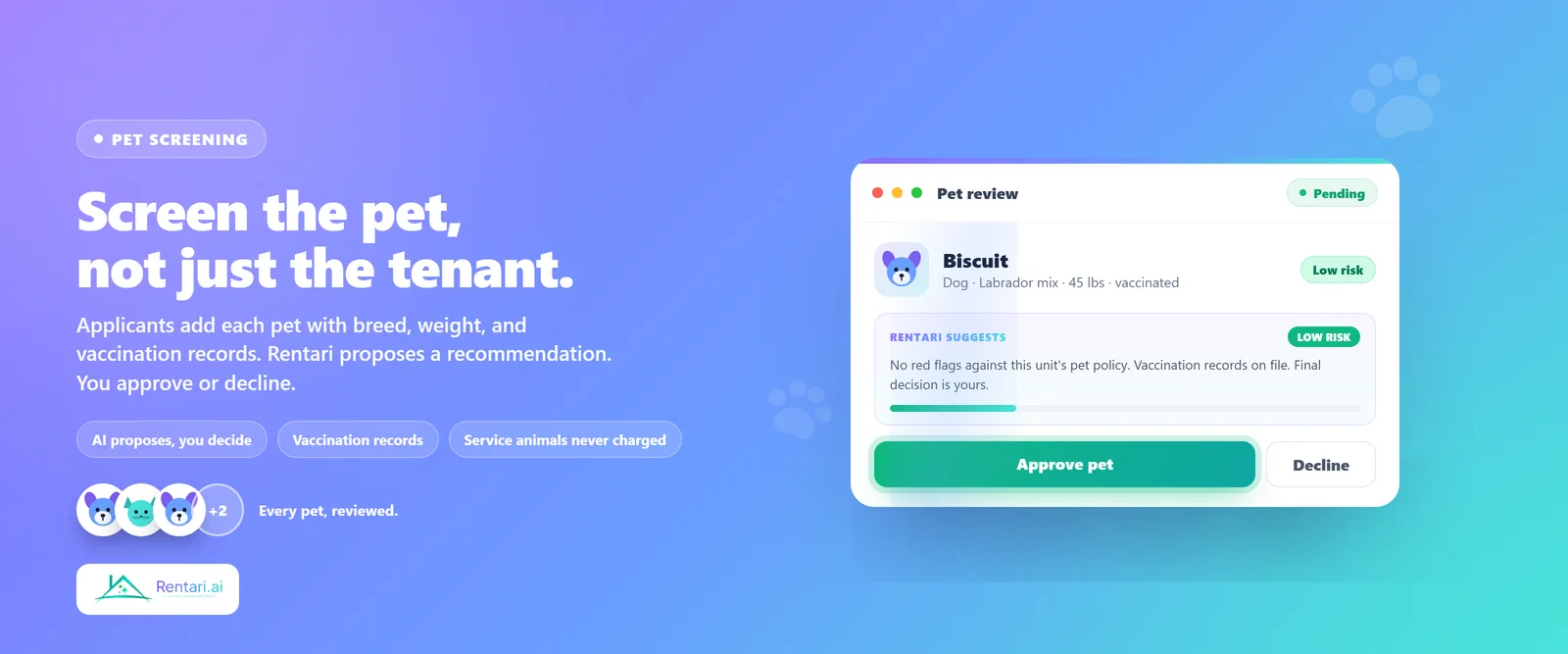
A pet is one of the most common sources of unit damage and deposit disputes, and the rules around assistance animals are one of the easiest places to land a fair-housing complaint. Most landlords decide on pets from a single yes-or-no question on the application, then meet the actual animal at move-in. Here is how to screen pets fairly, what you can and cannot ask, and how Rentari turns it into a short, documented review.
You are probably deciding on pets blind
On most rental applications the entire pet question is one line: do you have any pets, yes or no. A yes tells you nothing about the 90-pound dog, the breed your insurer excludes, whether it is house-trained, or whether its shots are current. So the decision that drives a real share of your turnover cost, scratched floors, chewed trim, odor, and the deposit fight that follows, gets made on almost no information. Screening the pet the way you screen the applicant closes that gap before anyone signs.
What you can ask about a pet, and what you cannot
For an ordinary pet you are entitled to the facts you need to manage the property: the species, the breed, the weight and age, whether it is spayed or neutered and house-trained, current vaccination records, and how it did at prior rentals. You can set a written pet policy with a weight limit, a count limit, and a required vaccination record, as long as you apply that same policy to every applicant. Breed restrictions are usually driven by what your liability insurer will and will not cover, and they are lawful for ordinary pets, but check your own policy before you lean on a breed list, because the cost of getting it wrong is a denied claim, not just an awkward conversation.
The one thing none of this applies to is an assistance animal, and that distinction is where pet screening most often goes wrong.
The assistance-animal line you must not cross
A service animal or an emotional-support animal is not a pet under the Fair Housing Act. You cannot charge a pet deposit, a pet fee, or pet rent for one, and you cannot apply a breed or weight restriction to it. For an emotional-support animal you may ask for a reasonable verification of the disability-related need, but you may not ask about the specific diagnosis or demand medical records. Handle these as reasonable-accommodation requests, not as pet reviews. Charging a pet fee on a verified assistance animal, or denying one on breed or weight, is one of the most common and most expensive fair-housing mistakes a landlord makes.
Write the pet policy once, apply it to everyone
Consistency is your defense. Decide in advance which pets you allow, the weight and count limits, the vaccination and spay-or-neuter expectations, and the pet rent or deposit you will charge within your state's caps. Put it in writing, attach it to the listing, and run every applicant through the same standard. A pet policy you apply evenly to all applicants is far easier to defend than a series of one-off judgment calls, and it is what keeps a reasonable pet rule from drifting into a discrimination claim.
How Rentari screens pets for you
Rentari builds the pet into the application instead of leaving it as an afterthought. When an applicant applies, they add each pet with its species, breed, weight, age, vaccination records, and prior-rental history. Rentari reads that against your unit's pet policy and proposes a recommendation, a low, medium, or high risk read with a short, plain reason, for example that a large dog exceeds a small-dogs-only policy, or that no vaccination records are on file. You see the recommendation next to an Approve and a Decline button, and you make the call. The AI proposes, you decide, and a decline keeps your written reason on the record.
The assistance-animal carve-out is built in, not bolted on. If a pet is flagged as a service animal or an emotional-support animal, Rentari does not score it as a pet or offer to charge it a fee. It routes the request to the reasonable-accommodation flow, where the Fair Housing rules apply, and it will block a lease from going out with a pet deposit, pet fee, or pet rent attached to a verified assistance animal. Current tenants can add a pet from their own portal mid-lease, so a pet that arrives after move-in still goes through the same short review rather than showing up as a surprise at renewal.
Keep the approval with the lease
Once you approve a pet, the terms belong on the lease: the pet itself, a pet addendum, and any pet rent or deposit. Pet deposit and pet rent limits vary by state, and several states restrict or cap recurring pet charges, so Rentari flags an amount that runs over your state's cap before the lease is dispatched rather than after the tenant disputes it. The result is a documented, even-handed record of which pets you allowed and why, which is exactly what you want on file if a deposit ever gets contested.
This article is general information for landlords and property managers, not legal advice. Fair Housing obligations around assistance animals, and state limits on pet deposits and pet rent, vary by jurisdiction and change over time. Confirm the rules for your state and consult counsel on specific situations. Details are current as of the date of publication.