Student and shared housing runs on a clock no other rental does. A leasing season squeezed into a few frantic weeks, an inquiry flood that hits every listing at once, a guarantor or co-signer behind nearly every application, and a full turn every single August. The right software does not just store all that, it absorbs the rush. This is an honest, price-and-capability look at the tools campus landlords and co-living operators actually use, and where Rentari.ai fits.
The shape of the problem: a season, not a year
Most rental software is built for a steady-state landlord who fills a vacancy now and then. Student and shared housing breaks that assumption. Demand arrives in a wave, peaks in a handful of weeks, and then goes quiet. During that wave a single near-campus listing can pull dozens of inquiries across email, a marketplace inbox, and text, most of them asking the same three questions. Miss a reply for a day and the prospect signs somewhere else.
On top of the compressed season sit two structural quirks. First, guarantors and co-signers on most applications, because a sophomore rarely has the income or credit history to qualify alone, so you are really screening two people per bed. Second, roommates who each want to pay their share rather than chasing one person for the whole rent. And then the whole thing turns over again next August. Software for this market lives or dies on how well it handles the rush, the screening doubling, and the turn.
What Rentari.ai does for campus landlords today
Rentari.ai is one flat plan with everything included, built so the AI does the heavy lifting and you stay in control. The rhythm is consistent across the product: the AI proposes, you approve, it runs, and the record holds. For student housing, four pieces matter most, and all four are live now.
- The AI leasing inbox is the hero. When the season hits, the leasing inbox pulls inquiries from your listings into one place and drafts grounded replies to the repetitive questions (rent, availability, pet policy, lease term). Luna can answer from your listing facts and propose the next step. You approve the replies, so nothing goes out in your name without your say-so, but the triage that used to eat your evenings during peak weeks is handled.
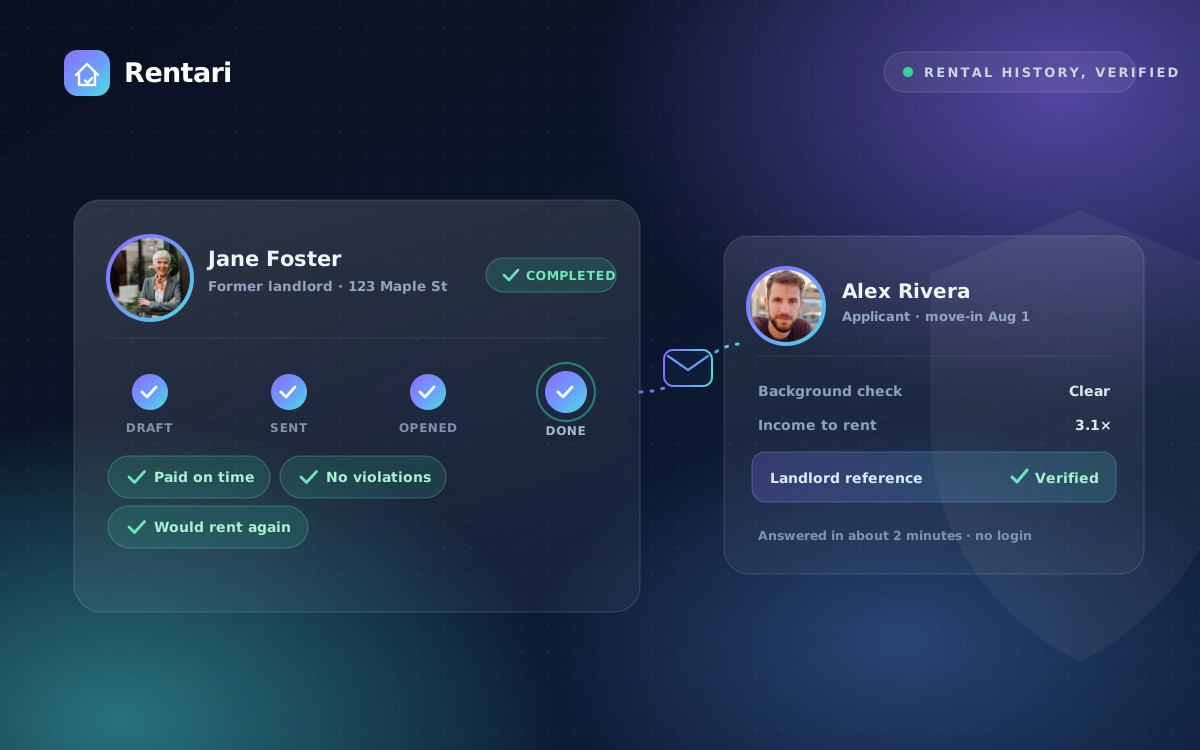
- Screening that covers the student and the guarantor. Rentari runs FCRA-aware screening on each applicant and each co-signer, consent-first. You can screen every roommate individually and every guarantor behind them today, which is exactly the doubling this market demands.
- 50-state leases with court-ready e-signature. Draft a lease, have it checked against the current state rules as you go (deposit caps, late-fee limits, notice windows), and send it for unlimited e-signature. No per-signature fee, no matter how many roommates and guarantors sign.
- Rent collection with autopay and automatic late fees. Tenants set up autopay, late fees apply by your rule, and the ledger updates without you touching a spreadsheet.
Running underneath all of it is Mozart, the landlord co-pilot, and Luna on the 24/7 maintenance line so a midnight "the heat is out" gets triaged into a ticket whether you pick up or not.
Honest line on by-the-bed
Today Rentari leases the unit and collects at the unit or lease level. Native per-resident ledgers, roommate matching, room assignment, and academic-year turn scheduling are on the near-term roadmap, not shipped. You can still screen each roommate and each guarantor right now. A large purpose-built community that needs by-the-bed accounting should keep its enterprise specialist for now.
Price and capability, side by side
Here is the comparison that matters for an independent campus landlord or a small co-living operator. The small-business tools (TurboTenant, Avail) are what most of this market actually runs on. The enterprise student-housing specialists (Entrata, RealPage Student, StarRez) are genuinely purpose-built for by-the-bed leasing, and genuinely heavy and expensive, with pricing you only see after a sales call.
| For student and shared housing landlords and PMs | Rentari.ai | TurboTenant | Avail | Entrata / RealPage Student / StarRez |
|---|---|---|---|---|
| AI leasing inbox for the season rush | Yes, drafts replies you approve | Lead inbox, lighter AI | Lead tracking, manual replies | Yes, enterprise CRM |
| Screen each roommate AND guarantor | Yes, both, consent-first | Per-applicant; guarantor manual | Per-applicant; guarantor manual | Yes, built for it |
| Unlimited e-sign (many co-signers) | Yes, no per-signature fee | Included | Included | Yes |
| By-the-bed / per-resident ledgers | On the roadmap (unit-level today) | No | No | Yes, the whole point |
| 24/7 maintenance phone triage | Yes, Luna app + phone | AI assistant, app-based | Request tracking | Yes, with a back office |
| All-in price for 25 units | $50/mo flat ($480/yr annual) | ~$10 to $17/mo | ~$7 to $9 per unit/mo | Custom quote, contract + setup |
Sources: each platform's public pricing and feature pages, mid-2026. Corrections are welcome and applied promptly.
Where the money actually goes
Rentari.ai is one flat plan, everything included. No per-signature fee, no per-payment fee, no setup fee, and no markup on the payment rail. Monthly billing is $10/month for the first 5 units, then $2 per added unit for units 6 through 200. On annual billing that works out to $8/month for the first 5 units ($96/year), then $1.60 per added unit. Above 200 units it moves to a custom Enterprise quote. So:
- 10 units is $20/mo, or $192/yr on annual.
- 25 units is $50/mo, or $480/yr.
- 50 units is $100/mo, or $960/yr.
- 100 units is $200/mo, or $1,920/yr.
The small-business tools are competitive on headline price. TurboTenant runs about $10 to $17 a month and has added an AI lease audit and an AI maintenance assistant, geared to 1-10 doors. Avail (by Realtor.com) has a free tier and an Unlimited Plus plan around $7 to $9 per unit a month, though on the free tier an about $2.50 ACH transfer fee gets passed to the tenant. Those are fine starter tools. They leave the leasing-season triage and the guarantor doubling largely manual, which is exactly the work that eats a campus landlord alive in August.
The enterprise specialists are a different category. Entrata, RealPage Student, and StarRez are purpose-built for by-the-bed leasing, roommate matching, and per-resident ledgers, and they do it well. They are also custom-quote, per-unit-with-minimums, annual-contract, implementation-fee products. That opacity is the honest contrast: with Rentari.ai you read the price on the pricing page and that is the price.
The honest split
For an independent campus landlord or a small co-living operator, Rentari.ai wins on the leasing inbox, guarantor screening, and the flat published price. For a 500-bed purpose-built community that needs native by-the-bed accounting today, the enterprise specialist is still the right tool until Rentari's by-the-bed ledgers ship.
What the AI will and will not do
Rentari.ai is deliberate about where AI stops. A few limits worth knowing before you decide:
- Mozart never signs or sends a lease by itself. It prepares the document and you sign your own name. It never runs a screening alone either, every screening is consent-first.
- Money-moving and signable actions are capped in the engine. They never auto-run and never get a one-click yes, only a typed confirmation. That cap holds in every pilot mode, all the way up to Autopilot, which you can read about on the pilot mode page.
- Accounting is categorized, not auto-pulled. Rentari does not reach into a bank feed. It categorizes what runs through the platform and the receipts you scan, then exports cleanly to QuickBooks or Xero. See the accounting page for how the Schedule E export works.
- Leases are checked against current state rules (deposit caps, late-fee limits, notice windows) as they are drafted, across all 50 states, with a legislation watch behind it.
- Evictions, refunds, and any contract a tenant or vendor signs always wait for you. No exceptions, regardless of mode.
How to decide for your campus portfolio
If you run a handful of houses or small buildings near a campus and the August inquiry flood is your real pain, the leasing inbox plus guarantor-aware screening plus a flat price is the strongest fit. You lease at the unit level today and screen every roommate and co-signer, which covers the structural quirks of this market without an enterprise contract. If you operate a large by-the-bed community where per-resident ledgers and room assignment are non-negotiable right now, keep your specialist and revisit Rentari when by-the-bed ships. For more on how the platform handles this vertical specifically, see the student housing market page.
Frequently asked questions
Can Rentari.ai screen a student's guarantor or co-signer, not just the student? Yes. Screening is FCRA-aware and consent-first, and you can run it on each roommate and each guarantor or co-signer behind them. That guarantor doubling is the norm in student housing, and it is fully supported today.
Does Rentari.ai support by-the-bed leasing and per-resident ledgers? Not yet. Today you lease the unit and collect at the unit or lease level. By-the-bed leasing, per-resident ledgers, roommate matching, room assignment, and academic-year turn scheduling are on the near-term roadmap. A large purpose-built community that needs by-the-bed accounting now should stay with an enterprise specialist for the moment.
How does the AI leasing inbox handle the season rush? During peak weeks it pulls inquiries from your listings into one place and drafts grounded replies to the repetitive questions. You approve the replies before anything goes out in your name, so the triage is handled without the AI ever sending on its own.
What does Rentari.ai cost for 25 student units? $50 a month flat on monthly billing, or $480 a year on annual billing. That is everything included: AI listings and syndication, the leasing inbox, screening, 50-state leases with unlimited e-signature, rent collection, 24/7 Luna maintenance, and accounting. No per-signature or per-payment fees.
Is there a per-signature fee when several roommates and guarantors sign a lease? No. E-signature is unlimited and included in the flat plan, which matters in this market where a single lease can carry several roommates plus a guarantor each.
The fastest way to judge any of this is to open the product. The seeded demo boots a furnished account so you can watch the leasing inbox triage a flood of inquiries, run a screening on a student and a guarantor, and draft a state-checked lease, all without signing up. Walk it through one full season in your head and decide for yourself.
Sources: each platform's public pricing and feature pages, mid-2026. This article is general information, not legal advice. Verify current pricing and your state and local rules before deciding.
Disclaimer: This post highlights certain features on each platform. This does not mean the other platforms do not have those features. Please do your own research before making any conclusions.