Most rental software can take a rent payment. The hard part was never the card form. It is the tenant who never set up a login, the deposit that legally cannot sit in your operating account, the roommate who pays her half on the 3rd, the housing authority that covers most of the rent but not all of it, the plumber waiting on an invoice, and the co-owner who wants her share. Here is how each of those actually works in Rentari.ai.
The rule underneath all of it: no markup on the rent
Start here, because it shapes everything else. Rentari.ai does not take a cut of the rent you collect. There is no per-lease fee, no percentage, and no platform slice skimmed on the way through. What you charge is what lands in your account, less the payment processor's own fee, which is real and which nobody can waive.
On the bank rail that processor fee is small and it is capped, and we split it with the tenant rather than quietly absorbing it into a higher rent or quietly passing all of it to one side. Cards cost meaningfully more, and they cost more the larger the rent is, which is why bank payments are the default everywhere in the product and why the card path asks the payer to acknowledge the surcharge before it will run. The number is always shown before anyone confirms. No payment in Rentari.ai charges an amount the payer has not already seen.
Autopay, for the tenant who wants to stop thinking about it
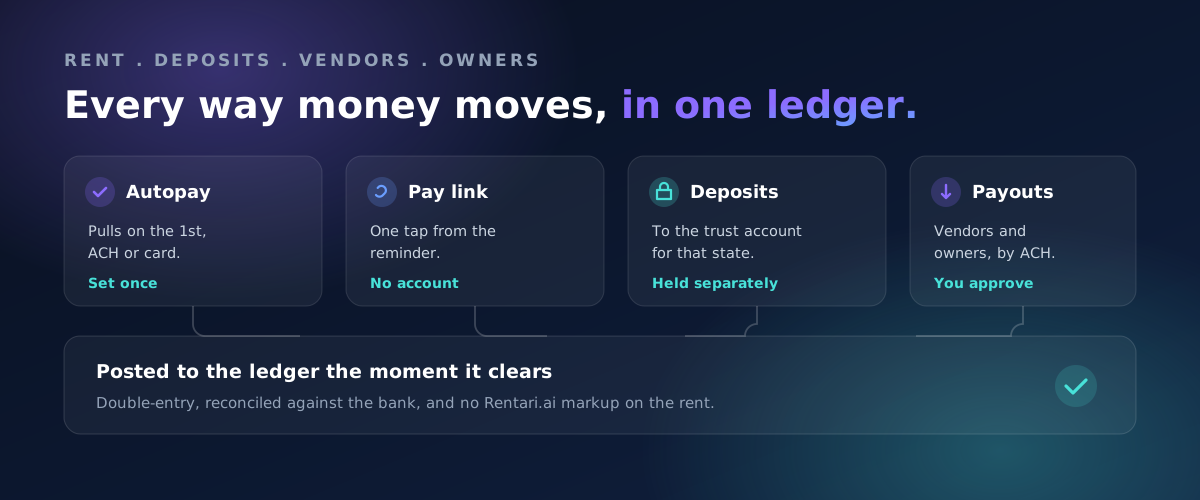
A tenant links a bank account or a card once in their portal and turns autopay on. On the due date it pulls by itself, every month, with no reminder needed and no action from you. It keeps working through a renewal: when the rent changes, the recurring amount is repriced to the new figure rather than quietly drawing last year's number.
Autopay is careful about one thing that trips up simpler systems. It draws the tenant's own portion, not the contract rent. If a housing authority or an employer covers part of the rent, autopay pulls what the tenant actually owes and the subsidy is reconciled separately. Drawing the full amount from a Section 8 tenant would be an overcharge, and it is the sort of overcharge that is easy to ship and hard to notice.
You can also invite a tenant to set autopay up, from the lease, with a link that takes them straight to the enrolment step.
The pay link, for the tenant who will never keep a password
This is the gap most portals never close. A large share of tenants will not create a login, or will create one and forget it by the second month. Every reminder those tenants get ends at a sign-in screen, which means every one of their payments is something you chase by hand.
So the reminder now carries a private payment link. One tap opens a page showing what they owe and takes the payment. No account, no password, nothing to install. You can also copy the same link off the rent roll and send it however you already talk to that person, which for a lot of tenants is a text message rather than email.
The details that make it safe to send: the amount is recalculated the moment they open it, so a late fee or an applied credit is always reflected rather than frozen at whatever it was when the email went out. The link expires. It can only ever settle that tenant's own balance into your account, so a forwarded link is not a way to reach anything else. Security deposits are deliberately excluded from it, for reasons in the next section. And your rent roll shows you when they opened it and when the money actually cleared, which are two different moments on the bank rail and are labelled as two different moments.
Deposits are not rent, and the product treats them that way
A security deposit is the tenant's money that you are holding. In many states that is not a figure of speech: the deposit legally cannot sit in your operating account, it may owe interest, and there are deadlines and itemization rules for giving it back.
So deposits move on their own path. They are collected on a dedicated page, and the charge is routed to the trust account for that property's state rather than to the account your rent lands in. That routing is why the no-login pay link refuses to touch a deposit: a link designed to be easy to forward should not be able to move money that is held in trust.
You can also record a deposit that arrived as a check, a money order, or cash, so the ledger matches reality instead of only knowing about the payments that happened to come through a card reader. At move-out, settling the deposit walks you through itemizing deductions, and what the tenant gets back is calculated from the itemization rather than typed in from memory.
Move-in, where more money moves at once than at any other point
The first bill of a tenancy is the messiest one: a partial first month, a full deposit, sometimes a pet fee, a holding fee taken during the application that now needs to be applied or refunded. Rentari.ai posts those charges to the tenant's ledger so they can pay before they get the keys, and it handles the arithmetic that people get wrong at the edges.
One of those edges is worth spelling out, because the obvious behaviour is the wrong one. Payment processors will not run a charge under fifty cents. A lease starting on the 29th of the month can produce a prorated first-month rent of, say, forty-eight cents. The tempting fix is to round it away to zero. That is quietly taking money off the landlord and telling nobody. Instead the amount is parked and added to the first full month's rent, so it appears as one collectable row and the landlord keeps every cent they are owed.
Rent that is split, and rent someone else pays
Not every lease is one tenant paying one amount.
- Roommates. A shared lease bills each roommate their own exact share, and the shares are computed so they add up to the rent with no rounding cent lost or invented.
- Subsidies and third-party payers. Section 8 housing assistance, a corporate tenancy, or a guarantor covering part of the rent each get their own portion. The tenant is billed their slice, the payer's portion is tracked separately, and the two reconcile to the contract rent.
- Co-signers. A co-signer can be sent an invoice and pay it from a page of their own, without an account, in the same spirit as the tenant pay link.
- One bill across a building. A water bill or a shared utility can be split across the units in one step, with each tenant billed their share and notified.
When rent runs late
Late fees are set once against the lease, with a grace period, and then apply themselves the same way every month rather than depending on whether anyone remembered. You can waive one in a click when the situation calls for it.
Reminders are a sequence, not a single nag: a five stage ladder from the balance being posted through to a final notice, each stage worded by you, each one able to be overridden for a particular building, and each with a minimum balance floor so nobody receives a serious-sounding email over two dollars and forty cents.
When a tenant genuinely falls behind, the AI drafts a structured catch-up plan that spreads the balance over a couple of paydays, along with the acceptance letter. It drafts. You approve. Nothing goes to the tenant until you have read it.
Money going out: vendors and owners
Payments are not only inbound. When a vendor finishes a job, you can pay the invoice by bank transfer straight to their account, with the processing fee split rather than dumped on the contractor. Sending money out asks you to re-confirm your identity first, because a payout is the one action where a hijacked session is most expensive.
For properties with outside owners, an owner's share can be sent as an ACH draw against their statement, so a distribution is a couple of clicks rather than a manual transfer that someone then has to remember to write down.
Payments you did not take online
Real portfolios have cash, checks, and money orders in them, and a system that only knows about its own card payments will always disagree with the bank. So you can record a rent payment or a deposit that arrived some other way, and it lands in the ledger like any other. If you record one by mistake, it can be reversed rather than left to be worked around.
Where it all ends up
Every payment above posts to the same ledger the moment it clears, with no manual entry. That is the part that turns payment features into accounting: rent, deposits, fees, splits, subsidies, vendor payouts and owner draws are all the same double-entry record by the time you look at a report.
From there, receipts go to both sides automatically, payouts can be reconciled back to the individual payments that made them up, and your books can be checked against the actual bank. Rentari.ai can connect to your bank account, pull transactions in, and have the AI propose a category for each one, which you approve or correct. The AI proposes. You decide. That is the same rule the rest of the product runs on, and it matters most where money is concerned.
The short version
Rent can pull itself, or be paid in one tap by someone who has never logged in. Deposits go where the law says they go. Split rent, subsidies and co-signers each get their own portion instead of being forced into a single payer. Vendors and owners get paid out of the same system. Cash and checks are recorded rather than ignored. And all of it lands in one ledger, so the question is never which system knows the truth.