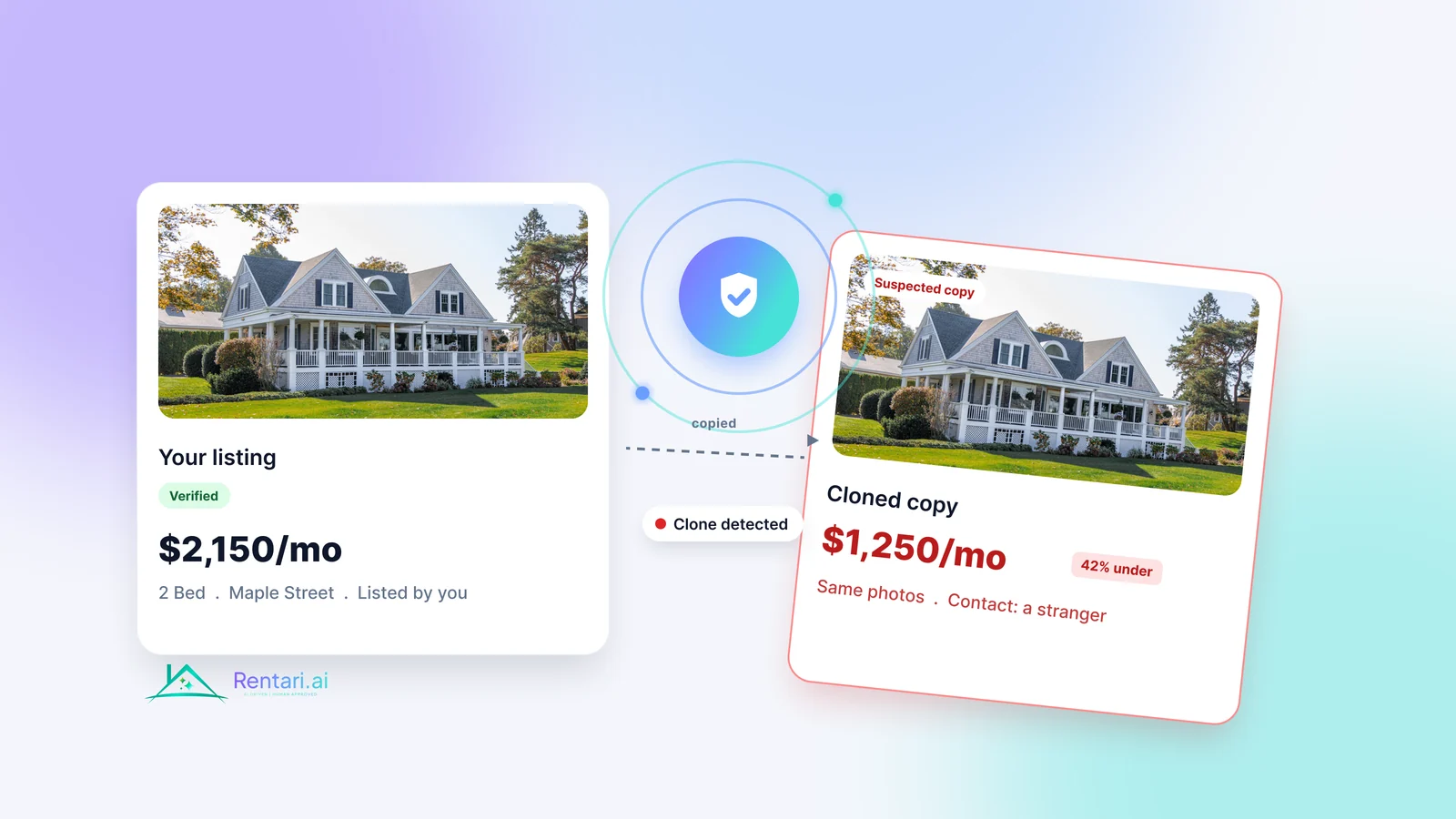
Listing fraud is one of the quietest threats a landlord faces. A scammer copies your real listing, drops the rent to a number that is too good to ignore, swaps in their own phone and email, and collects deposits from hopeful renters who think they are talking to you. You usually find out only when an angry applicant shows up at the door. Rentari.ai Listing Protection turns that reactive scramble into a quiet, automatic safety net.
The scam: your listing, their bank account
Rental listing fraud is a well-documented and growing problem, and the most common version is almost lazy in how it works. A scammer does not need to break into anything. They simply copy a listing you already posted in good faith: your photos, your description, your address, sometimes word for word. Then they change two things. They lower the rent to a price that feels like a steal, and they replace your contact details with their own.
They re-post that cloned listing on a classifieds site, a social marketplace, or a second-tier rental board. A renter finds it, falls for the price, and reaches out. The scammer plays the part of a busy or out-of-town owner, asks for a deposit or first month wired up front to "hold" the unit, and then disappears. The renter is out real money. And here is the part that stings: it all happened under your name and your address.
The damage is not only the victim's. It is yours too. A defrauded renter often does not realize there were two listings. They remember the address, your photos, and a bad experience, and your reputation takes the hit for a crime you did not commit. Meanwhile your real, honestly priced listing now has to compete with a fake that looks identical and costs less.
How people fight this today, and why it hurts
The standard defense against listing clones is almost entirely manual, and it is a chore. The usual playbook looks like this:
- Google yourself, over and over. Periodically search your own property address and your listing headline to see if a copy turns up somewhere. It works, when you remember to do it, when you have the time, and when the fake happens to surface in the results you check.
- Watermark your photos. Stamp your contact info or a logo onto your images so a copy is harder to pass off. Scammers crop, re-shoot, or simply use the unmarked photos they grabbed before you started watermarking.
- React after the fact. Wait until a confused renter calls or emails, then scramble to find the fake, file a takedown with whatever site is hosting it, and hope it comes down before someone else pays.
Every part of that is reactive, ongoing, and easy to let slip. It is the kind of task that lives at the bottom of the to-do list until the week a fraud actually happens.
It is worth being honest about where this falls in the wider toolset, because it explains why the chore keeps landing on you. The mainstream listing portals you syndicate to, and the property management platforms landlords use for screening, leases, and accounting, are built around getting your listing out, qualifying applicants, and keeping the books. Actively patrolling the open web for cloned copies of your specific listing, and flagging them back to you, is simply not something most platforms do for you. So the monitoring stays a manual habit, which in practice means it often does not happen at all.
The usual playbook vs Rentari.ai
- Finding fakes: the usual playbook is you, manually Googling your address when you remember. Rentari.ai scans the open web for copies of every published listing, automatically, every week.
- Watermarks: the usual playbook is hoping a stamp deters a copy. Rentari.ai looks for the copy itself, watermark or not.
- Timing: the usual playbook reacts after a renter is already out money. Rentari.ai is built for early detection, before more people get hurt.
- Effort: the usual playbook is a recurring weekly chore. Rentari.ai runs in the background with zero setup.
- Control: the usual playbook leaves the takedown entirely to you. Rentari.ai surfaces the find and prepares the case, then you decide.
How Rentari.ai Listing Protection works
Listing Protection (also called the Listing Fraud Monitor) takes the weekly Googling off your plate and does it properly. Once you publish a listing, it goes to work in the background. There is nothing to configure and nothing extra to buy.
Here is what it actually does. It uses AI with Google Search grounding to scan the open web for pages that advertise your listing's address and details, then judges each result against your real listing and flags the suspects. For every suspected copy it surfaces:
- The source link and the site it was found on, so you can open the page and see it yourself.
- The rent shown on the copy, which is often the tell, since clones tend to undercut your real price.
- A severity (high, medium, or low) so you know what to look at first.
- The reason it was flagged, in plain language, so the judgment is never a black box.
The cadence: weekly, plus whenever you want
Listing Protection runs an automatic weekly scan of every published listing, so the monitoring keeps happening even when you forget it exists. When you want a fresh read right now, there is a Scan all now button that re-checks every published listing on demand, and a per-listing Scan for fakes button to focus on one property. When something new turns up, you get an email and an in-app notification, so a find does not sit unseen.
You stay in control. Always.
This is the part we are deliberate about, because fraud handling is a place where a tool taking action on its own could do harm. Rentari.ai follows the same principle as the rest of the product: the AI proposes, you decide.
Every suspected copy lands as an alert for you to review. If it is a real clone, you confirm and report it. If it is a false match (your own cross-post, a legitimate syndication, a coincidence), you dismiss it. Rentari.ai surfaces the find and prepares the case, and that is where its job ends. Rentari.ai never contacts a site or takes anything down on its own. There is no auto-takedown. You are the one who decides what is fraud and what to do about it.
An honest word on the limits
A safety net is only useful if you understand its edges, so here is the straight version. Listing Protection finds copies that are publicly visible and indexed on the open web, which is exactly where the large majority of rental scam clones live, because a scammer needs renters to find the fake. That said, a brand-new post or a copy hidden behind a login may not appear right away. This is a strong, automatic safety net, not a guarantee that no clone can ever exist. What it does is turn a chore you would skip into a steady background check, and it catches the fakes that matter most: the ones out in the open, fishing for victims.
The benefits, concretely
- It protects your name and reputation. Catching a clone early means fewer renters defrauded in your name, and fewer people associating your address with a scam.
- It protects renters. The faster a fake comes down, the fewer people lose a deposit to it.
- Early detection beats cleanup. Finding a clone the week it appears is a different problem than learning about it from a victim a month later.
- It saves you the weekly chore. No more reminding yourself to Google your own address. It just runs.
- It keeps you in control. Every action waits for your call, so the system never overreaches on your behalf.
- It lives in one place. A dedicated dashboard shows how many listings are monitored, how many alerts are open, and what you have confirmed or resolved.
Why both independent landlords and property managers should turn it on
If you are an independent landlord, you are the brand. There is no marketing team to catch a clone and no compliance desk to field the angry calls. A single fraud against your listing lands squarely on you, your reputation, and your phone. An automatic monitor that runs without you thinking about it is exactly the kind of leverage a one-person operation needs.
If you are a property manager, the math only gets bigger. More listings means more surface area for scammers, more owners trusting you to protect their properties, and more renters whose trust rides on your name. Manually Googling dozens or hundreds of addresses is not realistic. Listing Protection scales the watch automatically across every published listing in the portfolio, which is why it is built in for landlords and property managers of all sizes.
Built in, not bolted on
Listing Protection is not a premium add-on or a separate subscription. It is part of the whole Rentari.ai platform, which is one flat price: from $8 a month for up to 5 units when billed annually, then $1.60 per added unit, up to 200. There is no fee when a tenant pays rent, no per-signature charge, and no separate add-on to unlock fraud monitoring. You publish a listing, and the protection turns on with it.
Listing fraud will not stop on its own, and the people running it are counting on you being too busy to notice. The honest answer is to stop relying on remembering to look, and let the watch run in the background. You can see Listing Protection live on its dashboard page, and the full feature is laid out on the public feature page.
This article is for general information about Rentari.ai Listing Protection and does not constitute legal advice. Listing Protection finds publicly indexed copies on the open web and is a safety net, not a guarantee. How you respond to a confirmed fraudulent listing, including reporting and takedown, is your decision. Pricing is current as of the date of publication.