Most property software buries the answer you want behind a dashboard, a filter, and an export. Rentari flips that around. You type the question the way you would say it out loud, and the AI answers from your own leases, payments, screening results, and documents, then shows you the record it used.
The problem: your own data is hard to ask
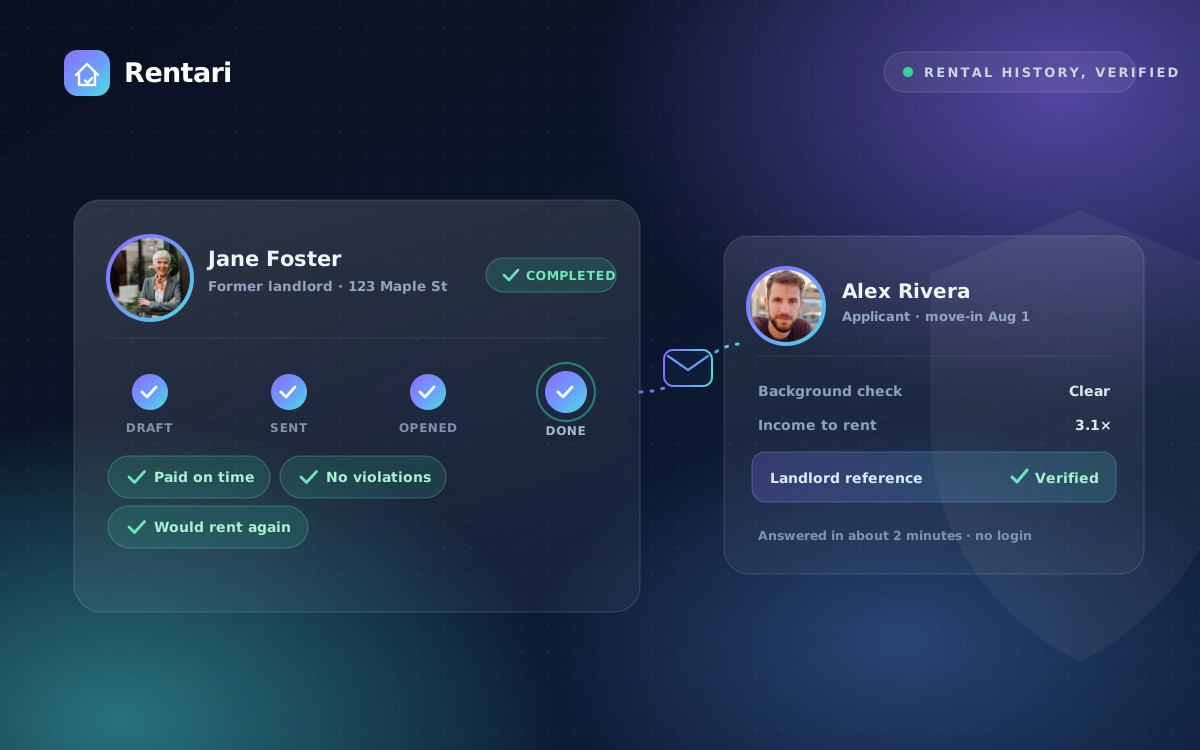
You already have the information. The lease end dates are in the system. So are the late payments, the screening results, the maintenance history, and the deposits. The trouble is getting a straight answer out of it. To find out which leases expire this quarter, you open a report, set a date filter, and read a table. To see who is behind on rent, you open another screen. To check whether an applicant passed their background check, you dig into the screening tab. Every answer is one more place to look.
That friction is why so much of a landlord's day is spent navigating software instead of making decisions. The data is not the bottleneck. The asking is.
What if you could just ask?
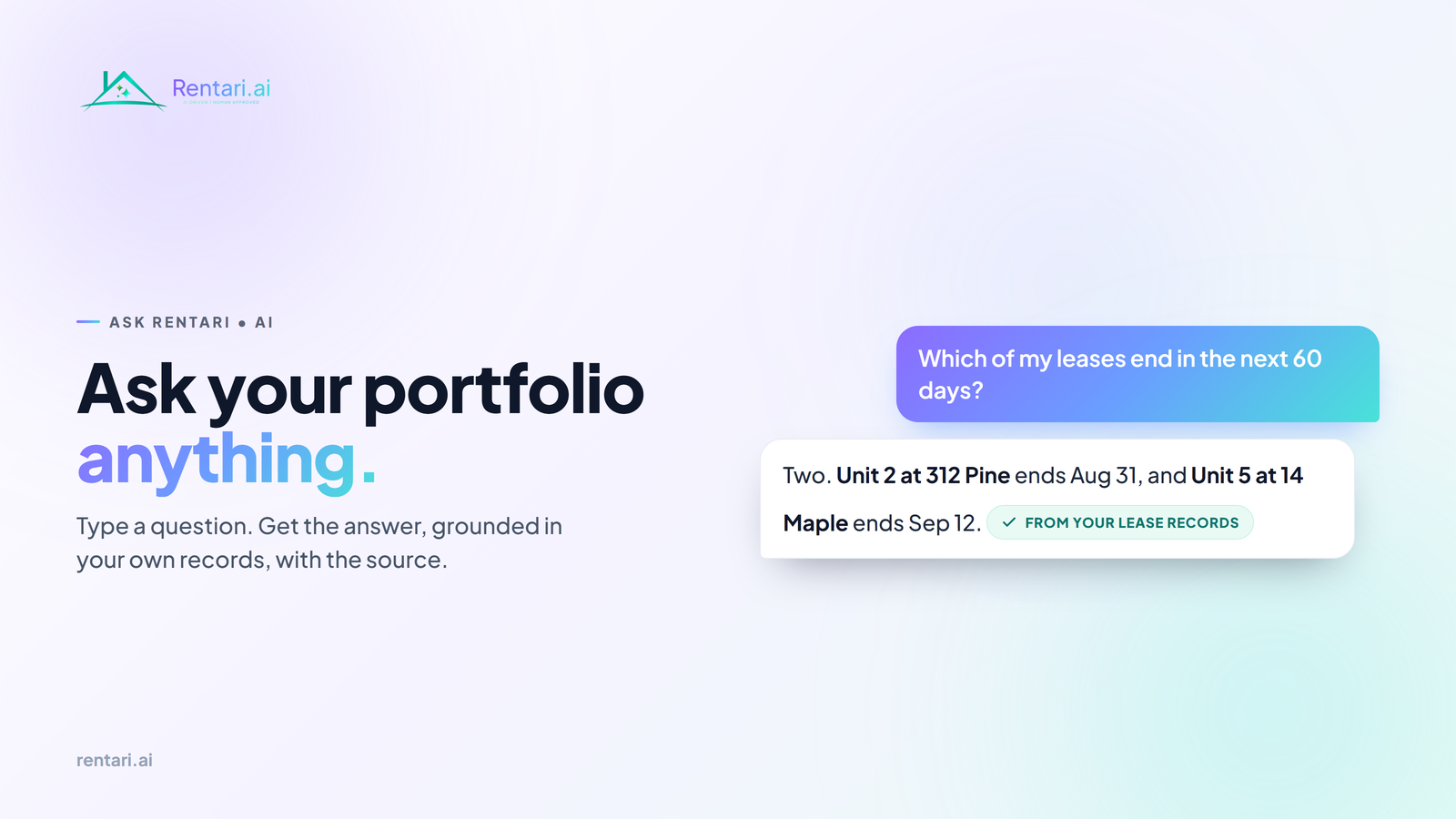
Rentari puts a question box on top of your whole portfolio. Type a plain-English question and get a plain-English answer:
- Which of my leases end in the next 60 days?
- Who is late on rent this month?
- Has any applicant passed their background check yet?
- What did I spend on repairs at Maple Street this year?
- Who still owes a security deposit?
No filters to set, no report to build, no tab to remember. You ask across every property at once and the answer comes back in seconds. Two assistants power this. Atlas answers from your documents, leases, and applicant screening on the Online Documents page. Mozart, the AI operator, answers across the entire portfolio, including the ledger, tenants, maintenance, and money.
The honest part
When the answer is not in your records, the AI says so and points you to the page to add it. It does not invent a gate code, a balance, or a date to fill the silence.
Grounded, not guessed
This is the difference that matters, and it is easy to get wrong. A general chatbot will happily make up a plausible answer. That is fine for brainstorming and dangerous for a business where the numbers are real money and the records carry legal weight.
Rentari's assistants are built to answer only from what is actually on file. Every reply quotes the record behind it, so you can check it. If a fact has not been entered, the assistant tells you it is not on file instead of guessing, and routes you to where you would add it. The result is an assistant you can trust with a rent balance or a screening result, because it will not confidently tell you something that is not true.
Ask, then act
An answer is often the start of a task. Once you know a lease is ending or a tenant is late, the natural next step is to do something about it. So the same assistant can prepare that step. Ask Mozart to draft the late notice, message a tenant, post a payment, or build a renewal, and it puts the action together and waits.
Nothing sends, charges, or files on its own. The AI proposes and you decide. You can run it as a Co-pilot that drafts and waits for every approval, in a Mixed mode where routine work flows and big calls pause for you, or in Autopilot for the steps you have chosen to trust. Eviction filings, refunds, and anything a tenant or vendor signs always wait for your explicit yes.
Private by design
Asking software about your tenants raises a fair question: where does that data go? Rentari scopes every answer to your portfolio alone, so you can never see another landlord's records and they can never see yours. Sensitive identity details, like a Social Security number or a date of birth, are never sent to the AI at all. And because each answer traces back to a real record you can open, you are never taking the assistant's word for it.
How Rentari can offer this
Two things make this possible. First, Rentari already stores your portfolio as structured records, not loose files: leases, ledger entries, screening results, and tagged documents all live in one connected system. That structure is what lets an assistant retrieve the exact record that answers your question. Second, modern AI models are now good enough to read those records and respond in plain language, while staying inside guardrails that keep them honest.
Just as important is what we did not do: we did not bolt a generic chatbot onto a marketing page. The assistants read your real data, cite it, abstain when they should, and hand every write action back to you for approval. That is harder to build, and it is the only version worth shipping for a tool that touches money and leases.
Included, not an upsell
The AI is part of the product, not a premium tier. Rentari is one flat price: from $8 a month for up to 5 units when billed annually, then $1.60 for each added unit, up to 200. Screening, leases, rent, maintenance, accounting, and the AI that answers your questions are all in that one number. There is no fee when a tenant pays rent, no per-signature charge, and no separate add-on to unlock the assistant. You ask your portfolio anything, and the cost per unit keeps falling as you grow.
This article describes how Rentari's AI assistants work today. The assistants answer from your own records and prepare actions for your approval; they do not provide legal, tax, or financial advice. Pricing is current as of June 2026.