Most property tools ask you to trust the AI or turn it off. Rentari.ai gives you a dial instead. Every AI action carries a risk tier, money and legal moves can never auto-run, and you choose co-pilot, mixed, or autopilot for each feature.
The problem with "autonomous" property AI
The pitch for AI property management usually arrives as a binary. Either the assistant runs on its own and you hope it gets things right, or you keep it on a leash and lose most of the value. Neither is comfortable when the actions in question are charging a tenant a late fee, sending a renewal at a new rent, or starting an eviction notice. Those are not the kinds of decisions you want a model making quietly at 2 a.m.
Rentari.ai is built around a different idea: the AI proposes, you approve, and nothing happens behind your back. That sentence is easy to write on a marketing page. What makes it real is the architecture underneath it, a control layer that sits in front of every action the AI can take and decides whether it may run on its own or has to wait for you.
Every action carries a risk tier
Inside Rentari.ai, each automatable action is registered with a risk tier from 0 to 3. The tier describes how much damage a mistake could do, not how clever the action is.
- Tier 0 is read-only. Looking something up, summarizing a ledger, surfacing an offline sensor.
- Tier 1 is reversible. Drafting a listing, opening a low-priority inspection ticket, suggesting a price you have not published yet.
- Tier 2 reaches a real person. A rent reminder to a tenant, an escalation email to a vendor.
- Tier 3 moves money, signs, or is otherwise hard to undo. Applying a charge, issuing a refund, dispatching an eviction notice, stamping a signature.
The tier is not cosmetic. It changes what the system is allowed to do without you.
The hard cap: Tier 3 can never auto-run
This is the part we will not bend on. A Tier 3 action can never resolve to autopilot, no matter what mode a landlord is on. It is enforced in one place, the function every action passes through before it touches your data, and again by a startup check that refuses to boot the app if any money or destructive action is ever marked auto-eligible. So even a landlord who flips everything to autopilot still gets a typed confirmation in front of a refund or an eviction.
This is deliberate, and it is permanent by design. Money, legal, and eviction actions always require a human confirmation. We treat that not as a limitation to apologize for but as the feature: the cap is what lets you turn the rest of the system loose without lying awake about it.
The honest framing. This is the opposite of a black box. You are not asked to trust an opaque agent or switch it off. You dial exactly how much the AI does, feature by feature, and the actions that could hurt you are capped so they always come back to you first.
Three modes, chosen per feature
On top of the risk tiers sits a pilot framework with three modes. The difference from a single on/off switch is that you can set them per feature, not just once for the whole account.
- Co-pilot. The AI proposes, you approve everything. Every action arrives as an approve-or-skip card in your inbox, with one-click email and optional text approvals.
- Mixed. Routine, low-stakes workflows run on their own while judgment calls stay held for you. This is where most landlords settle. You let rent reminders and reminders to yourself flow, and you keep tenant-facing and money-adjacent actions on co-pilot.
- Autopilot. Routine workflows run end to end. You are notified after the fact rather than asked first. The Tier 3 cap still applies, so this never includes money or legal actions.
Each automatable feature lives in a registry with its own default mode, so a brand-new action shows up with a sensible setting rather than silently inheriting autopilot. Outbound-to-tenant actions default to co-pilot on purpose. A timing bug in a cron should never spam your tenants without you seeing it first.
When the AI is unsure, it calls you in
The last layer is confidence-based escalation. An action can carry a confidence score. If an autopilot action's confidence falls below the bar for its risk tier, it does not run. It escalates to a human approval instead. The bar rises with the tier, so the same uncertainty that is fine for a reversible Tier 1 draft will hold a Tier 2 outbound message for your review. In plain terms: the more an action could matter, the surer the AI has to be before it acts alone, and when it is not sure, it hands the decision back to you.
How this compares
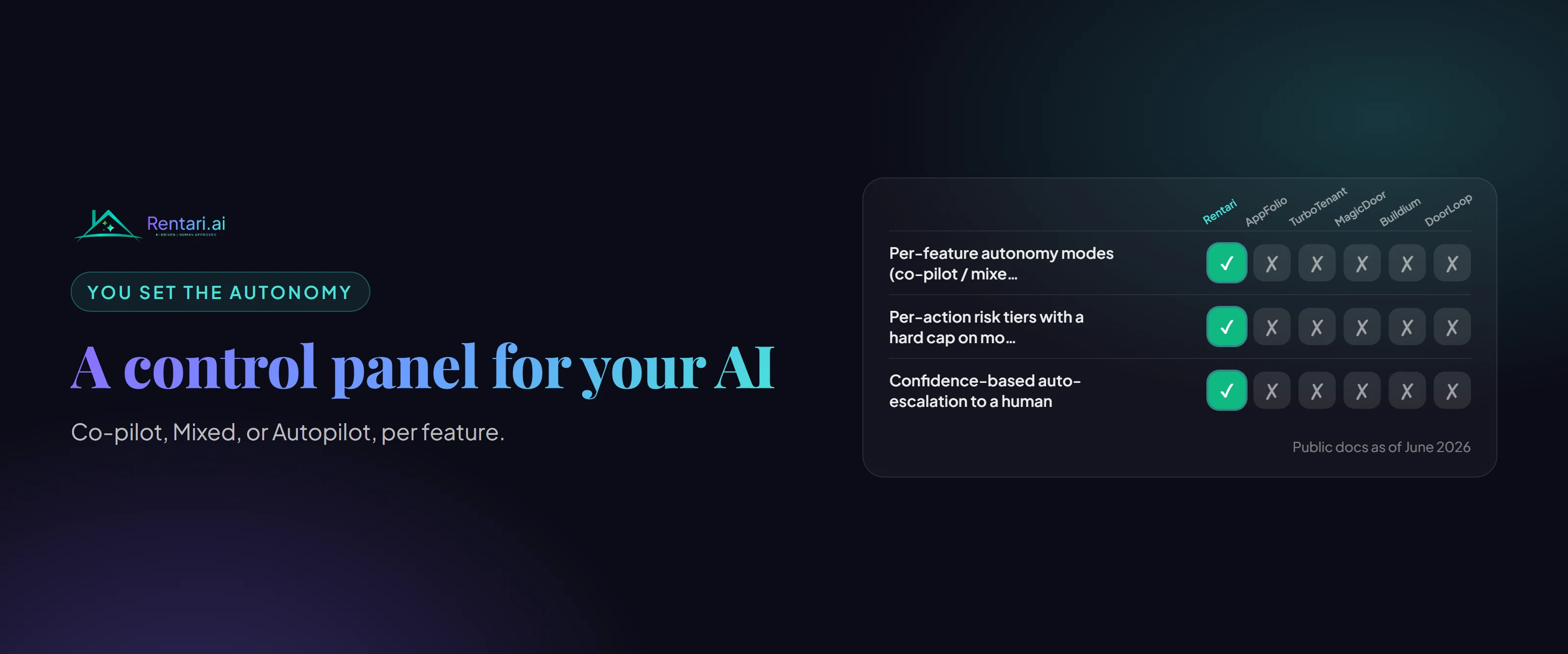
Several competitors ship capable agentic AI. AppFolio's Realm-X runs autonomous workflows, Buildium has its Lumina agents, DoorLoop, TurboTenant, and MagicDoor all ship AI that takes action. What we did not find, based on each vendor's public documentation as of June 2026, is a landlord-facing control surface that exposes per-feature autonomy modes, a published risk-tier model with a hard cap on money and legal actions, and confidence-based auto-escalation. AppFolio offers workflow automation rules, which is real and useful, but that is a rules engine, not a co-pilot, mixed, or autopilot selector you set per feature.
| Capability | Rentari.ai | AppFolio | TurboTenant | MagicDoor | Buildium | DoorLoop |
|---|---|---|---|---|---|---|
| Per-feature autonomy modes (co-pilot / mixed / autopilot) | Yes | No | No | No | No | No |
| Per-action risk tiers with a hard cap on money/legal actions | Yes | No | No | No | No | No |
| Confidence-based auto-escalation to a human | Yes | No | No | No | No | No |
Based on each vendor's public documentation as of June 2026.
Why it is built this way
A control panel is only worth building if the actions behind it are real. Rentari.ai's framework already governs dozens of registered actions across rent collection, renewals, maintenance, compliance, and onboarding, each with its own tier and default mode. The point is not to maximize how much the AI does. It is to let you decide, with full visibility, and to make the riskiest decisions structurally impossible to take without you. That is what a control panel for an AI property manager should mean.
Take the scorecard with you
This card is the post in one image, the same one we share on Facebook. Save it, or send it to a landlord friend who is comparing tools.