State landlord-tenant law changes every session, and most landlords and property managers find out the hard way. Rentari ingests new state legislation, classifies it, and alerts only the landlords it actually affects, then audits each lease against that state's deposit, late-fee, and grace-period limits before it is dispatched. It is a heads-up and a pre-flight check, not legal advice.
Compliance is the quiet risk in self-managed rentals. A late-fee that was legal last year can be over the cap this year. A deposit that was fine in one state would be a violation across a border. Most landlords find out when a tenant pushes back, or worse, in front of a judge. The information exists in public legislative records, but reading every bill in every state you operate in is not a job a person does well by hand.
Rentari treats this as two jobs that belong together: watch the law as it changes, and check each lease against the law before it goes out. Here is exactly how each one works, and where it stops short on purpose.
Watching the law: ingest, classify, then alert only who it affects
Once a day, Rentari polls public legislative data for the states it monitors and pulls the bills with any landlord-tenant signal: security deposit, eviction, habitability, fair housing, rent control, disclosure, fees, screening. Each candidate is classified into a category and an impact level (low, medium, high, critical), and tagged with a confidence score.
The part that matters is the alert. Rentari does not blast every landlord with every bill. When a new law lands, it looks at which landlords have an active lease on a property in that state, and notifies only those landlords. A Texas owner does not get a notification about an Oregon rent-control bill. The alert points to the compliance area of the dashboard so the next step is one click, not a research project.
This is deliberately a heads-up, not a verdict. A summary of a new bill carries an editorial review state. Lower-impact, high-confidence items can publish automatically, but anything with real consequence is held as a draft pending human review, and every generated summary carries a plain disclaimer: this is a draft, not legal advice, have your attorney review it before you act, and verify it against the official bill text. The point is to put the right bill in front of the right landlord early, not to tell anyone what a court will decide.
Auditing the lease: a pre-flight check before it is dispatched
The second job runs on the document itself. As a landlord builds a lease, Rentari checks the numbers against that state's rules in real time and again as a hard gate before the lease is generated. The checks that fire on every lease include:
- Security deposit cap. If a state limits deposits to a multiple of monthly rent and the lease exceeds it, the field is flagged with the maximum legal amount.
- Late-fee cap. States cap late fees as a flat amount, a percentage of rent, or the lesser or greater of the two. Rentari applies the right formulation per state and surfaces the legal ceiling.
- Grace period. Where a state requires a minimum number of days before any late fee can be assessed, a shorter grace period is flagged with the statutory minimum.
The same engine also covers notice-to-enter, month-to-month termination notice, source-of-income protection, and renewal rent-increase caps, with a statute citation attached to each warning. A landlord sees the issue inline while typing, not after a five-step round trip, and the generate step holds as the final gate so a non-compliant lease does not slip out the door.
The takeaway: Most tools wait for you to upload a lease and ask "is this one okay?" Rentari does that pre-dispatch audit too, and adds the part we did not find in any rival for landlords and property managers: it watches new state bills as they move and tells only the landlords each one affects, before anyone uploads anything. Watch, then check. Both, on the record.
How this compares
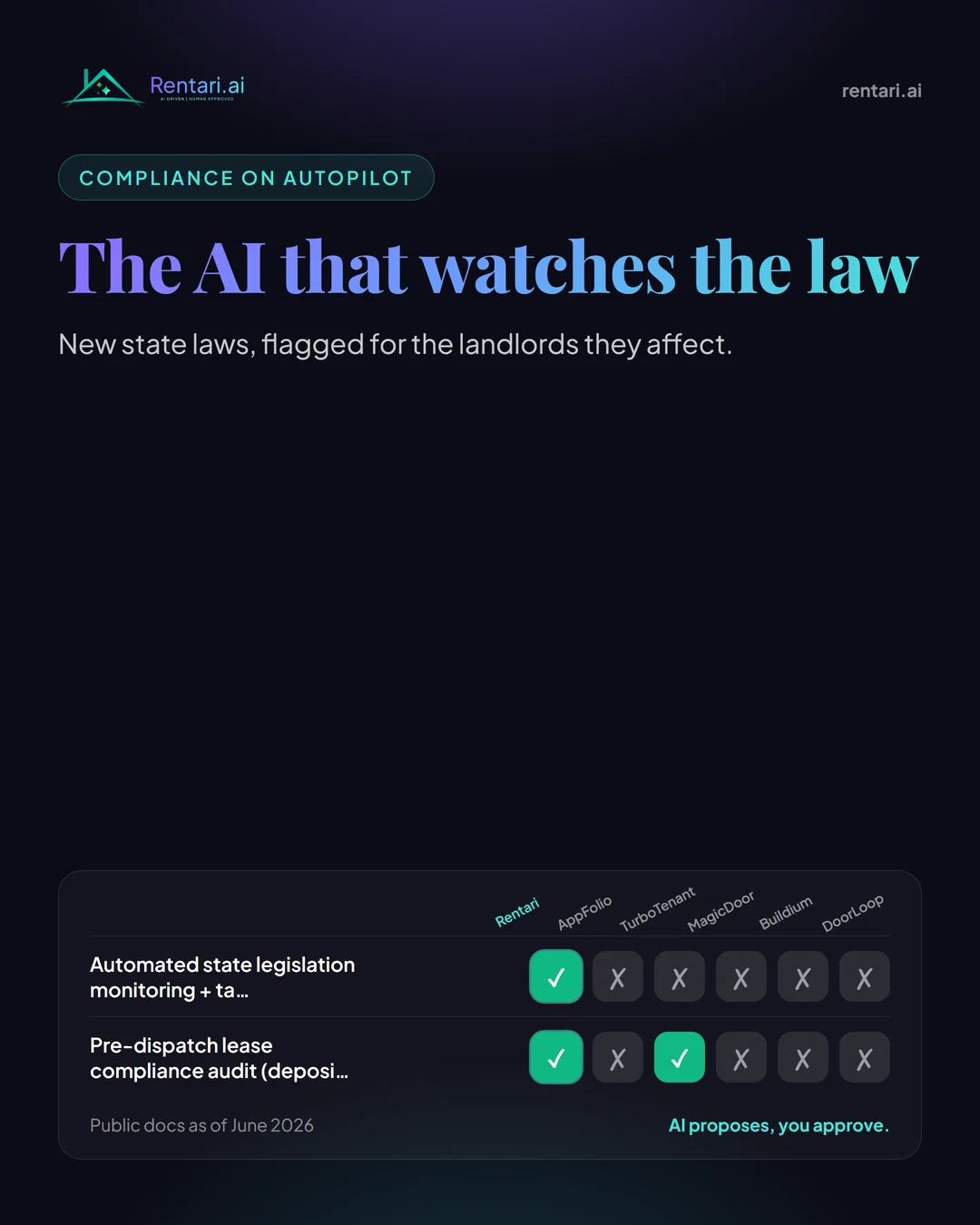
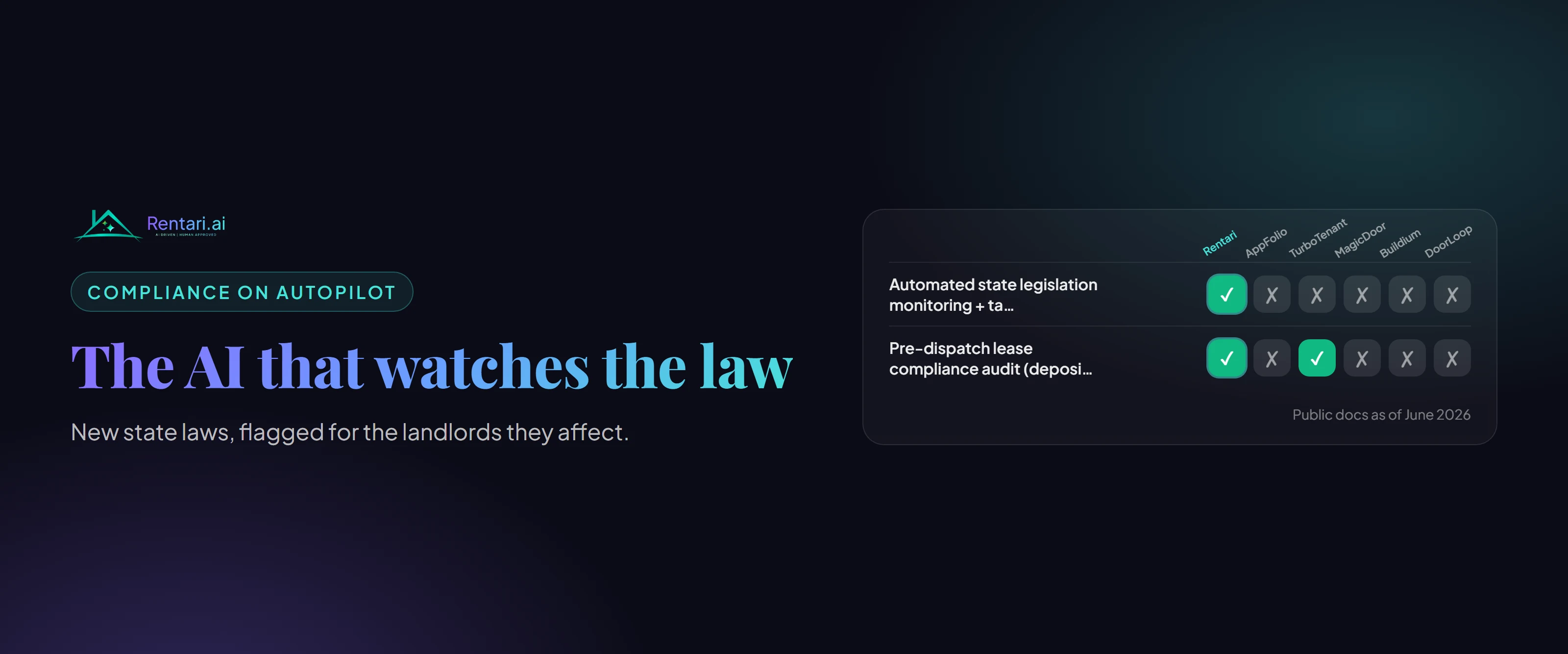
To be fair to the field: several tools now audit a lease for compliance, and TurboTenant's Lease Agreement Audit AI is genuinely good at it, scanning an uploaded lease against state deposit, late-fee, and grace-period rules. That is a real capability and it earns a Yes below. What we did not find, based on each vendor's public documentation as of June 2026, is a second tool that proactively monitors new state legislation and pushes a targeted alert to only the landlords each bill affects.
| Capability | Rentari.ai | AppFolio | TurboTenant | MagicDoor | Buildium | DoorLoop |
|---|---|---|---|---|---|---|
| Automated state legislation monitoring + targeted landlord alerts | Yes | No | No | No | No | No |
| Pre-dispatch lease compliance audit (deposit / late-fee / grace by state) | Yes | No | Yes | No | No | No |
Based on each vendor's public documentation as of June 2026. TurboTenant's Lease Agreement Audit AI checks an uploaded lease for state deposit, late-fee, and grace-period compliance, so it earns a Yes on the audit row; we found no proactive legislation-monitoring-plus-targeted-alert feature from any competitor.
What it is, and what it is not
Rentari is honest about the boundary here. The legislation watch is an early-warning system: it surfaces the bill and routes it to the landlords who hold a lease in that state. The lease audit is a numbers check against published state rules. Neither is legal advice, and the product says so on the summaries themselves. Consequential summaries wait for human review before they publish, and the recommendation on any draft is the same one a careful landlord would give: have an attorney look before you send it to a tenant.
That restraint is the feature. The goal is not to replace a lawyer. It is to make sure you are never the last to know your state changed the rules, and never the one who dispatched a lease over the line by accident.
Take the scorecard with you
This card is the post in one image, the same one we share on Facebook. Save it, or send it to a landlord friend who is comparing tools.