A property AI that confidently invents a gate code, a wifi password, or a fee is not a convenience. It is a trust and liability problem. Rentari's tenant assistant Luna answers only from the tenant's real lease, payment, and ticket data, and when it does not hold a fact, it says so and routes the question to you. The answer comes back, and it is saved so the same question never escalates twice.
Ask most rental chatbots what the gate code is, and many will give you one. It will sound certain. It will be formatted neatly. And there is a real chance it is wrong, because the model never had the code and filled the gap with a plausible-looking guess. In a property context, a confident wrong answer is worse than no answer. A tenant who keys in a fabricated gate code, pays a fee that was never owed, or sets out the trash on an invented pickup day learns one thing fast: the assistant cannot be trusted. After that, every answer is second-guessed, and the tool stops saving anyone time.
Rentari took the opposite design decision. Our tenant assistant, Luna, is built to say "I do not have that on file" rather than guess. This post explains how that works, how the same rule protects you on the landlord side through our co-pilot Mozart, and what happens to the question after Luna abstains.
What "abstain" actually means
Luna answers from one place: the tenant's own real records. The signed lease, the payment ledger, open maintenance tickets, lease dates, deposit and late-fee terms. When a tenant asks something those records can answer, Luna answers it and quotes the amounts and dates exactly as they appear.
When a tenant asks about a concrete property fact that is not in those records, Luna does not improvise. The gate or callbox code, the wifi password, trash and recycling day, the assigned parking space, an appliance brand, an unlisted fee, a preferred vendor: if it is not on file, Luna says it is not on file and points the tenant to message their property manager. It does not estimate. It does not substitute a typical value.
The keystone is a rule that is easy to state and easy for a careless system to break: an absent piece of data means "not on file," it does not mean zero, none, or not applicable. If Luna cannot see a late-fee amount, it does not assume there is no late fee. It abstains and asks you. This grounding rule lives in exactly one place in our codebase and is joined into every tenant chat surface, so a new feature cannot quietly ship a version of Luna that skips it.
The same discipline on the landlord side
Mozart, the landlord co-pilot, runs the portfolio side with the same honesty, tuned for a different blast radius. Mozart has read access across your properties, tenants, ledgers, and leases, so it tries its tools first and abstains only after they come back empty, then names the dashboard tab where you can confirm. The danger here is money and identity, so the rule is sharper: an absent, empty, or truncated data section means "not shown," never "$0 owed," "no tenants," or "nothing overdue." A co-pilot that reads an omitted section as zero would tell you a tenant owes nothing when in fact the data simply was not loaded. Mozart will not do that. It tells you it cannot see it rather than inventing a clean balance.
This is also the place to be clear about autonomy. Rentari's AI proposes, you approve. Nothing happens behind your back. Money, legal, and eviction actions always require a typed confirmation from a human by design. The never-guess rule and the approval gate are two halves of the same promise: the AI does the work, and you stay in control of every move that matters.
The takeaway: The most useful thing a property AI can do is know the limits of what it knows. Luna answers from the tenant's real lease and records, abstains the moment it would have to guess a property fact, and routes that question to you. Mozart treats missing data as "not on file," never as zero. An assistant that never invents a gate code or a fee is one a tenant can actually rely on.
Abstaining is only half the job. The loop is the other half.
An assistant that only ever says "ask your manager" would get annoying quickly. So abstaining is not the end of the interaction, it is the start of a durable loop.
When Luna abstains, it opens a tracked question to the property manager rather than dropping it. The manager sees it, answers once, and that answer does two things at the same time. It returns to the tenant who asked, and, if the manager opts in, it is promoted into a per-property knowledge base that Luna reads from going forward. The next tenant who asks the same building's wifi password or trash day gets the answer directly from Luna, because it is now on file. The question that escalated once does not escalate again.
We deliberately do not auto-fill that knowledge base with AI guesses. The starter list a manager sees (building wifi, trash and recycling days, parking, gate code, appliance brands, quiet hours, pet policy, after-hours emergency contact) ships as blank questions, never as AI-generated facts. Auto-filling them would reintroduce the exact hallucination the whole system exists to prevent. A human supplies the truth once, then it scales.
How this compares
Plenty of platforms now let a tenant "ask about their lease," and that is genuinely useful. The differentiator is not whether a tenant can chat with an AI. It is what the AI does at the edge of what it knows, and whether the abstention turns into durable institutional knowledge instead of a dead end. Based on each vendor's public documentation as of June 2026, here is how the three capabilities behind this feature line up. This is the only set of tools we found documenting these specific behaviors as of that date.
| Capability | Rentari.ai | AppFolio | TurboTenant | MagicDoor | Buildium | DoorLoop |
|---|---|---|---|---|---|---|
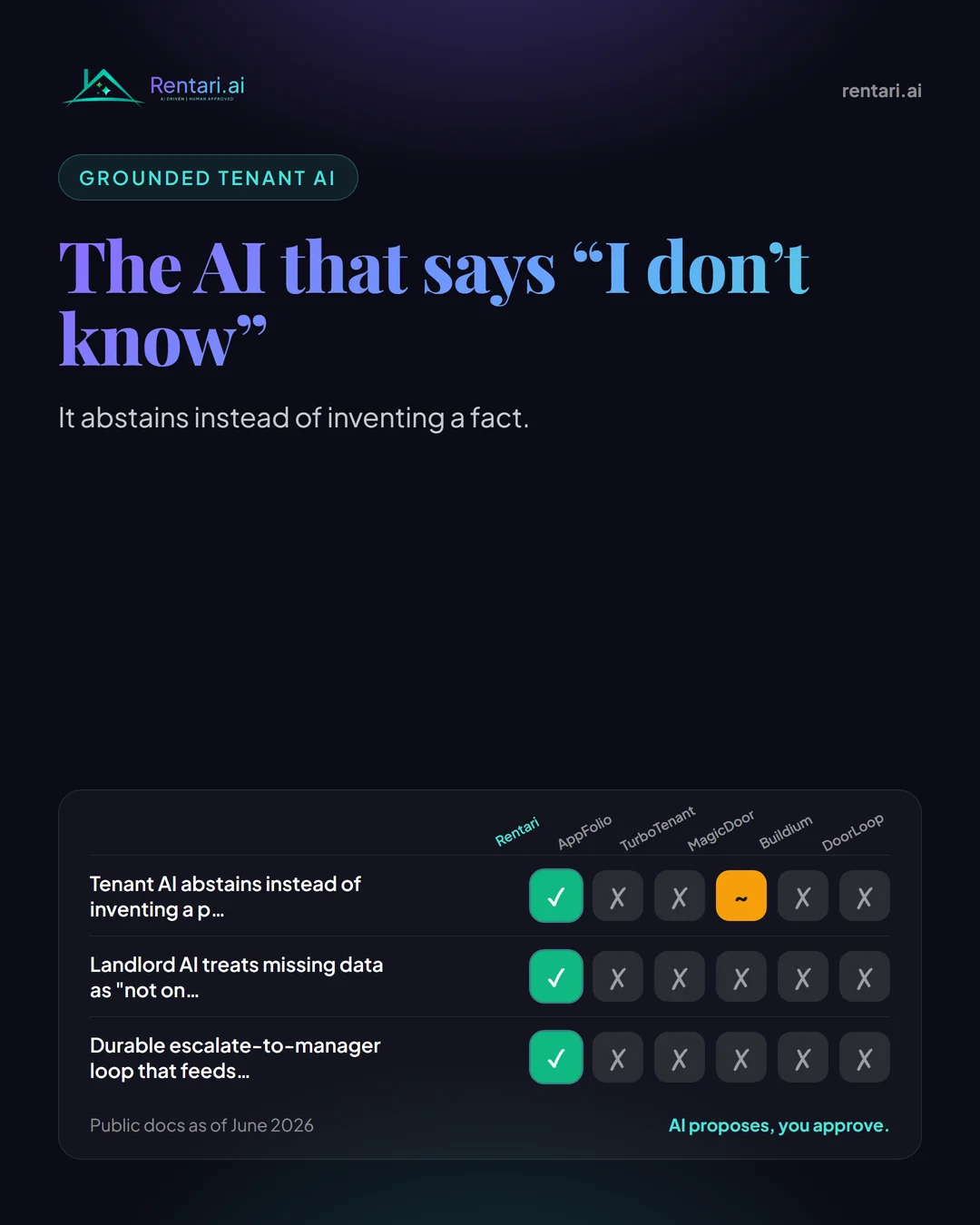
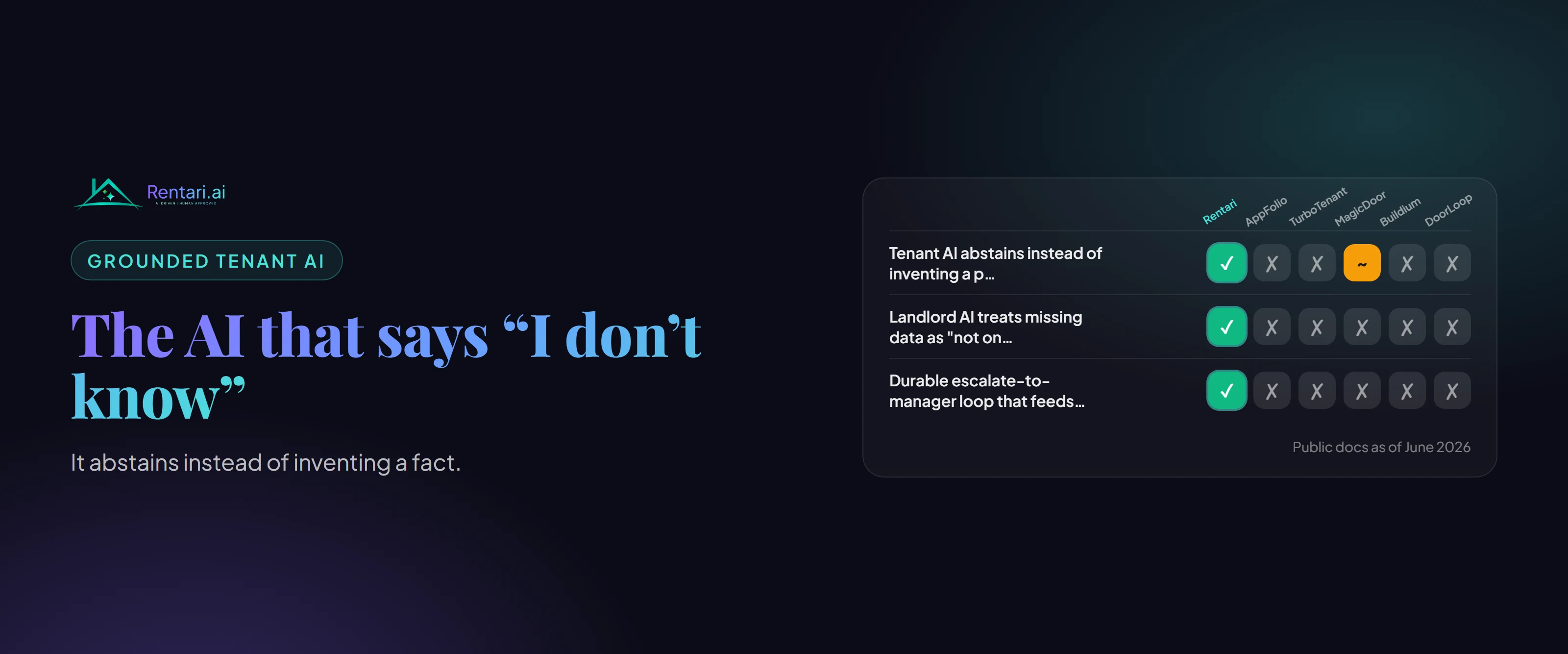
| Tenant AI abstains instead of inventing a property fact | Yes | No | No | Partial | No | No |
| Landlord AI treats missing data as "not on file," not zero | Yes | No | No | No | No | No |
| Durable escalate-to-manager loop that feeds a knowledge base | Yes | No | No | No | No | No |
Based on each vendor's public documentation as of June 2026. MagicDoor is rated Partial on the first row because tenants can ask about their lease, but we found no documented abstain or never-guess mechanism.
MagicDoor earns the Partial honestly: its tenants can ask about their lease and it markets "accurate, immediate answers," which is a real and good capability. What we could not find documented is a mechanism that makes the AI decline to answer when it does not hold the fact, which is the specific behavior these rows measure. The others ship strong AI in other areas (AppFolio's autonomous agents, Buildium's AI workforce, DoorLoop's assistant), but none publish a tenant-side abstain rule, a landlord-side missing-equals-not-zero contract, or a closed escalation loop that promotes a human answer into a reusable knowledge base.
Why the limits are the feature
It is tempting to judge an assistant by how many questions it answers. The better measure is how many it answers correctly, and whether it knows when to stop. A gate code that is right 95 percent of the time is not 95 percent useful. The 5 percent locks a tenant out, generates an angry call, and quietly erodes confidence in every other answer. By refusing to guess, Luna keeps its answers worth trusting, and the escalation loop means each honest "I do not know" becomes a permanent "here it is" for the next person who asks.
Take the scorecard with you
This card is the post in one image, the same one we share on Facebook. Save it, or send it to a landlord friend who is comparing tools.