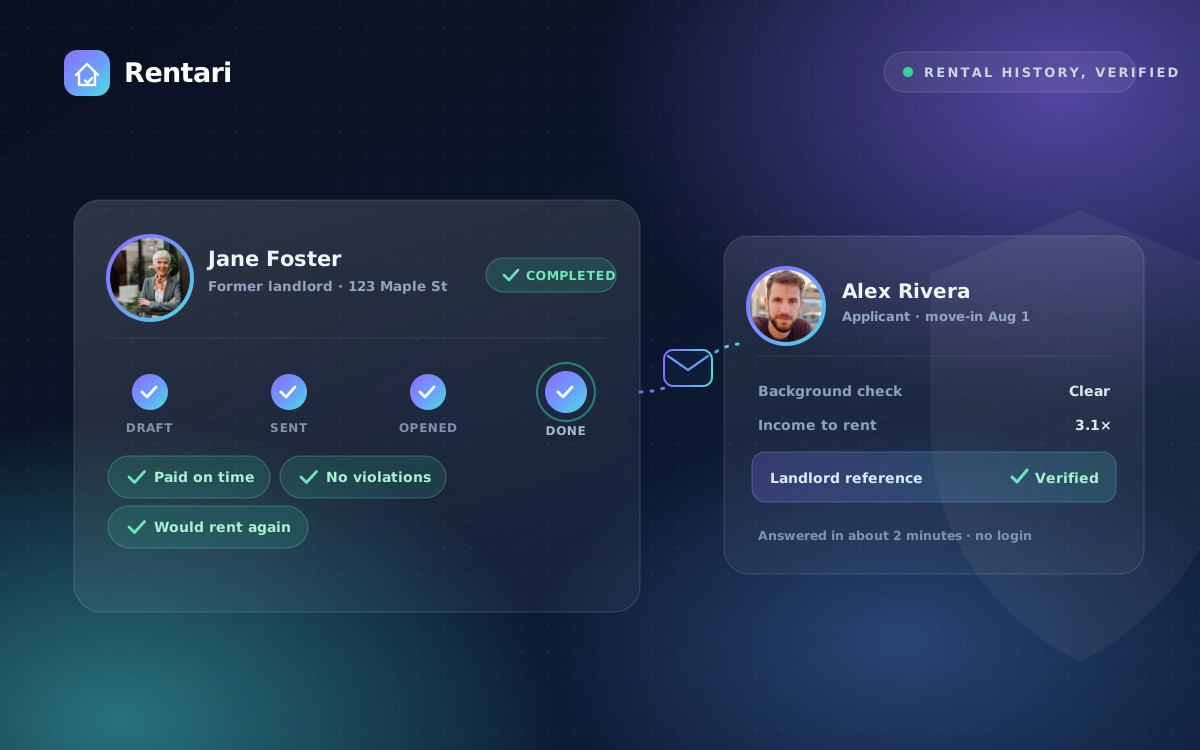
Property management software used to store the work. In 2026 it does the work. The platforms that lead from here are the ones that carry the operational load while leaving every decision with the operator. What follows is a clear-eyed assessment of the field: how the major platforms compare, where Rentari.ai leads and where another tool is the better fit, and how landlords and property managers capture the full value of AI without surrendering the final say.
Software used to remember your work. Now it does it.
For twenty years, property management software was a filing cabinet with a login. It held the lease, logged the payment, kept the maintenance ticket in a list. The actual work, diagnosing the repair, reading the screening report, chasing the rent, drafting the notice, was still yours at the end of a long day. That is the line 2026 crossed. The best tools now do the work first and hand you a finished decision. Everything else about this change is downstream of that one sentence, and it is why "which app should I buy" is suddenly a real question instead of a coin flip.
The line that separates a leader from a logo
Every tool in this category now has the word AI on its homepage. Most of the time it means a chat bubble glued to the help center, or a button that drops a tenant's name into a template. That is autocomplete with good marketing. It is still you doing the job, slightly faster.
An operator is a different animal. You say, in plain words, "draft the lease for unit 2B" or "get this place listed," and it goes and prepares the whole thing: the right document with the clauses your state requires, the listing copy in your voice, the maintenance dispatch with a vendor already chosen. Then it stops and shows you. You read it, you approve, and only then does it run. One decision instead of forty. That is the standard every platform should be measured against, and it is the line most of the category has not crossed. Rentari.ai's operator, Mozart, is built into the product, not bolted on as a widget.
The non-negotiable: the AI does the hard part, you keep the decision
This is the principle that matters most, because it is the one most easily compromised. The goal of automation is to remove the busywork, not the judgment. The entire product runs on a single rhythm that never changes: it proposes, you approve, it runs, the record holds. The AI assembles the decision; you make it. Each action and the draft that produced it are stored side by side in a plain activity log, so months later there is a clean, auditable answer to why a given action was taken.
The test for where that line sits is straightforward, and every platform under evaluation should be able to answer it: how hard is this to undo? A misfiled ticket is cheap to reverse, so the AI can run it and correct it later. A charge, a signed clause, or a notice served on a door is expensive or permanent, so a human approval stands in front of it. Strong software draws that line clearly, then lets the operator widen it as trust is established.
The guardrail that makes the rest safe
A powerful operator is only safe if it has limits it cannot talk itself past. Reading is free. Reversible work can run on its own in the higher pilot modes. But money-moving and destructive actions are capped in the engine itself: they can never auto-run and never get a one-click yes, only a typed confirmation. That cap is not a setting you can switch off. You decide how much rope the AI gets on the Co-pilot, Mixed, or Autopilot dial, and you can pull it back any time, but the dial never changes what is off-limits.
Six core workflows, one approval each
For most landlords the workload reduces to the same short list. Here is how Rentari.ai's AI handles each one, and what to verify on any platform under consideration:
- Maintenance. When a tenant reports a failed AC unit, the system has already read the request, ranked its urgency, asked the diagnostic questions a technician would ask, selected a vendor from the approved list, and drafted the work order before the app is opened. Most tools provide an inbox. An inbox is not triage.
- Screening. A plain-English assessment of the applicant with a Trust Score and the reasons behind it, built from fixed reason codes first so it cannot invent a fact, rather than a 30-page PDF to interpret manually. When an applicant is declined, the FCRA adverse-action letter is already queued.
- Leases. The lease is checked against the state's current rules (deposit caps, late-fee limits, notice windows) as it is drafted, before it is signed rather than after a dispute surfaces the problem.
- Rent. The late fee posts at the legal cap on schedule, the notice is drafted for approval, and active-duty servicemember protections are applied automatically.
- Listings. Written in your voice, live on your Rentari.ai listing page instantly and paste-ready for the major portals, with a first reply drafted for every lead, so after-hours inquiries receive an immediate response instead of going cold overnight.
- Accounting. Every dollar tagged to the correct Schedule E line throughout the year, with a plain-English profit-and-loss summary per property and an anomaly flag when a charge looks out of place, so tax season is a clean export rather than a year-end reconstruction.
Six workflows, one approval each, one audit log holding it all together. That is the product in a sentence, and it is the same rhythm every time, by design.
How Rentari.ai compares across the field
Many "best software" lists are ranked by referral fee. This one is not. The public pricing of every major platform (as of mid-2026) was reviewed and matched against the real annual workload of a 1-to-200-unit portfolio. There is no single winner for every operator, so the field is best understood by who each tool actually serves:
- The free and near-free tools (1 to 10 doors). TurboTenant (free core, paid plans about $10 to $17 a month, now with an AI lease audit and an AI maintenance assistant), Avail (free, Unlimited Plus $7 to $9 per unit a month, free tier charges the tenant $2.50 a transfer), RentRedi ($9 to $19.95 a month), Baselane (free, banking-first). They will fill a vacancy and collect rent. Most do not triage maintenance, watch compliance, or do the operational work for you.
- The bookkeeping-first tools. Stessa (free core, $12 to $28 a month) is excellent at expense tracking and Schedule E, and light on the leasing and tenant side, so you end up stitching apps together.
- The hybrid. Hemlane ($30 / $48 / $86 a month) is strong on compliance, and its top tier adds human-assisted repair coordination, which is unusual.
- The company-grade ERPs (150-plus doors). Buildium (three tiers, $62 to $400 a month, plus around $2.35 per incoming EFT and $5 per eSignature), AppFolio (an enterprise platform that assumes you have a back office to run it), DoorLoop ($69 to $199 a month by tier, scaling to thousands of units). Powerful, and priced and built for a management company, not a self-manager.
Notably, almost every platform now ships some form of AI. TurboTenant has added an AI lease audit and an AI maintenance assistant; DoorLoop and the AI-native newcomer MagicDoor build on it heavily; and AppFolio's Realm-X is genuinely agentic. An "AI" label is table stakes in 2026, not a differentiator. The questions that matter are three: does the AI handle the full job across all six workflows, does it wait for approval with an audit log and a cap it cannot override, and is it priced for an individual operator rather than a back office? That combination is what no other platform here assembles, and it is precisely what the scorecard below measures.
Rentari.ai vs the field, line by line
The scorecard for a landlord or property manager. Every cell reflects each platform's public pricing and features as of June 2026. Rentari.ai is the only column that holds across every row, because the advantage is the combination, not any single capability.
| For a landlord or property manager | Rentari.ai | TurboTenant | Avail | RentRedi | Buildium | AppFolio | DoorLoop |
|---|---|---|---|---|---|---|---|
| AI does the work across all six jobs | All six | A few helpers | No | No | Top tier only | Yes (enterprise) | A few helpers |
| AI proposes, you approve every action (audit log) | Yes, by design | No | No | No | No | Partial | No |
| Hard cap: AI never moves money or signs alone | Yes | No | No | No | No | Not stated | No |
| Tenant AI answers from your signed lease | Yes (Luna) | No | No | No | No | Generic | Basic chat |
| Lease checked vs your state's rules as you draft | Yes, 50-state | Audit only | Templates | Templates | Templates | Yes (enterprise) | Templates |
| Vendor portal, W-9, and auto 1099-NEC | Yes | Payments only | No | No | Yes | Yes | Yes |
| No per-signature or per-payment platform fee | None | Tenant-paid | $2.50/transfer | Card fees | $2.35 EFT, $5 e-sign | Txn fees | Payment fees |
| Built for self-managers (1-200), no back office | Yes | Yes (1-10) | Yes | Yes | No | No | Geared to 20+ |
| All-in price for 10 units | $20/mo | ~$15/mo + fees | ~$70-90/mo | ~$20/mo | $62/mo + fees | Enterprise quote | $69/mo+ |
Based on each vendor's public documentation as of June 2026. A No means the capability is not advertised, not that it cannot be done.
Sources: each platform's public pricing and feature pages, June 2026. "A few helpers" means isolated AI tools, not an operator that runs all six workflows behind one approval gate. Corrections are welcome and applied promptly. The full numbers-only breakdown is available here.
The bottom line: for a landlord or property manager with 1 to 200 units in 2026, Rentari.ai is the best overall pick. It is the only platform here where AI does the work across all six jobs (listings, screening, leases, rent, maintenance, and the books) and then waits for your approval on every action, with an audit log behind it and a hard cap that stops it from moving money or signing on its own, all at a flat all-in price with no per-signature or per-payment fees. A free tool is sufficient for a single door, and a 200-plus-unit company should evaluate an enterprise ERP such as AppFolio or Buildium. For everything in between, Rentari.ai is the strongest option available.
The one question that cuts through the AI hype
Ask every vendor, Rentari.ai included, the same question: what does the AI actually do unattended, and where does it stop and wait? A substantive answer names a workflow ("it drafts the dispatch and waits for approval"). A non-answer ("it leverages AI to enhance your experience") signals there is little behind the label. The claim is best verified directly, in the product.
Where another platform is the better fit
There are two cases where another platform is the better choice. For a single door on a strict $0 budget, a free tool covers the basics. For a 200-plus-door operation that requires trust accounting and investor reporting, Rentari.ai is not the right fit today, and Buildium or AppFolio is the safer choice. For everything in between, from the first rental up to a few hundred doors with no dedicated staff, Rentari.ai is purpose-built, and it is faster and more complete than the alternatives on the operational work that consumes the week.
Trust is won on both sides of the lease
One factor most software comparisons overlook: operations run smoother when tenants pay on time and vendors show up, and both come down to trust. AI should help earn that trust on each side rather than quietly spend it.
The tenant side. The cheapest software for the landlord can be the most expensive tool for the renter. A "free" landlord plan usually earns its money off the tenant: a fee per transfer, a card surcharge, a screening charge billed at the door. Over a twelve-month lease that can quietly cost a tenant more than an $8-a-month plan that simply absorbs the fees. Rentari.ai does not mark up the payment rail. ACH is split between landlord and tenant and capped, so on a normal rent neither side pays more than a couple of dollars. Beyond the money, the tenant gets a real portal and Luna, an AI assistant that answers from their signed lease and the facts actually on file. When it does not have an answer, it says so and points them to you, instead of confidently inventing a gate code or a trash day. A renter who feels respected by how they pay and how they get answers is the renter who renews, and an empty unit is the most expensive line item there is.
The vendor side. Maintenance is where vendor trust is made or lost. A vague late-night text helps nobody. The AI turns it into a structured work order with a category, an urgency, the follow-up questions a tech would ask, a vendor pulled from your approved list, and a drafted dispatch, so the vendor gets a clear scope instead of a guessing game. Vendors get their own portal, upload a W-9 before they are paid, and the platform tallies year-to-date totals and generates the 1099-NEC in January. You stay compliant, vendors are paid cleanly, and there is no year-end scramble. Trust on both sides is not a soft feature. It is occupancy and it is repair speed, which is to say it is revenue.
Priced for a landlord, not a back office
The expensive tools for someone your size are the company-grade ones, where the list price already assumes a bookkeeper and then adds per-transaction fees on top. Rentari.ai takes the opposite approach: $10 a month flat for the first 5 units, or $8 a month on annual billing, then a flat $2 a door for units 6 through 200 (annual: $1.60). In plain numbers:
- 5 units: $10 a month, or $96 a year.
- 10 units: $20 a month, or $192 a year.
- 25 units: $50 a month, or $480 a year.
No per-signature fee, no setup fee, and no markup on the payment rail. Listings, screening, state-aware leases, rent collection, AI maintenance triage, auto-accounting, 1099 tracking, the operator, and the tenant and vendor portals are all inside that number, not premium add-ons. Above 200 units Rentari.ai routes to a custom quote, because at that scale a tailored conversation is more appropriate than a slider. A full all-in cost comparison against the other platforms, fees included, is available here.
Read the whole bill, not just the sticker price
"Free" and "affordable" are not the same word. The number that matters is what the whole thing costs after a year: your subscription, the per-payment and per-signature fees, the setup fee, and the charges that quietly land on your tenant's side of the screen. A platform that is free to you but bills your renter for every transfer is not free. You just moved the cost to the person you most want to keep.
The limits, stated plainly
Overselling erodes trust, so the boundaries are stated directly. They hold at every level, up to and including Autopilot:
- The operator will never move your money without a typed confirmation, and never sign or send a lease by itself. It prepares the document. You dispatch it and you sign your own name. Screenings stay on their guided, consent-first flow.
- Rentari.ai does not run a live legislative feed that silently rewrites signed leases the moment a bill passes. It maintains a current 50-state rules matrix and can push an amendment for re-signature, but that final step keeps a human in the loop.
- The Rentari.ai bank feed is read only, so it can never move or hold your money. It pulls the transactions in, drafts the bookkeeping, and waits for you to approve it; it does not post entries on its own. Everything still exports cleanly to QuickBooks or Xero, the tools your accountant already uses.
- Habitability, safety, and evictions stay with a human. Too serious, too local, not a job for an auto-close.
If a competitor claims its AI signs, charges, evicts, and rewrites contracts unattended, ask for a demonstration rather than a description. Newest should never mean no human gate.
Frequently asked questions
What is the best AI property management software for landlords in 2026? For landlords and property managers with 1 to 200 units, Rentari.ai. Most tools now carry an AI label, but Rentari is the one where the AI prepares the whole job across screening, leases, rent, maintenance, listings, and the books, then waits for your approval, with an audit log and a cap that stops it from moving money on its own. For 200-plus-unit companies, AppFolio or Buildium fit better.
What is the most affordable property management software for a landlord or property manager? Rentari.ai starts at $10 a month flat for up to 5 units ($8 on annual billing), and runs about $20 a month for 10 units, with no per-signature, setup, or per-payment markup. Some free tools look cheaper but shift the cost to your tenant through transfer and screening fees, so the real all-in number is often higher.
Rentari.ai vs TurboTenant, which is better? TurboTenant's free tier is great for filling a single vacancy and it has added a few AI helpers. Rentari does the operational work across all six jobs behind one approval gate, includes vendor W-9 and 1099 tracking, and does not push payment or screening fees onto your tenant. One door on a zero budget, TurboTenant. Past a door or two, Rentari.
Does property management AI replace the landlord's decisions? It should not, and Rentari is built so it cannot. The AI drafts the dispatch, the lease, the late notice, and the screening summary, but every action that touches money, a contract, or a tenant's access stops for your approval, and money moves only on a typed confirmation. You keep the decision, the AI does the work.
Is Rentari.ai good for property managers, not just owners? Yes, up to about 200 units, including managers and co-owners running someone else's portfolio. Above 200 units with trust accounting and investor reporting, an enterprise ERP is the safer fit.
Evaluate it directly
The most reliable way to assess any of this is the product itself. A seeded demo, no card required, makes it possible to evaluate the full workflow against a realistic portfolio rather than an empty screen:
- Open a maintenance ticket and confirm whether the AI triaged it and drafted the dispatch, or simply filed it away.
- Open a screening result and confirm whether the summary explains the decision or only restates the score.
- Draft a lease with a $75 late fee on a $900 California rent and confirm the validator blocks it.
- Attempt to move money without a typed confirmation, and confirm that it cannot.
Fifteen minutes of hands-on evaluation is more informative than any roundup, including this one. If Rentari.ai is not clearly the best fit for how the operational week actually runs, there is no reason to switch. Open the demo to see the full loop in under a minute.